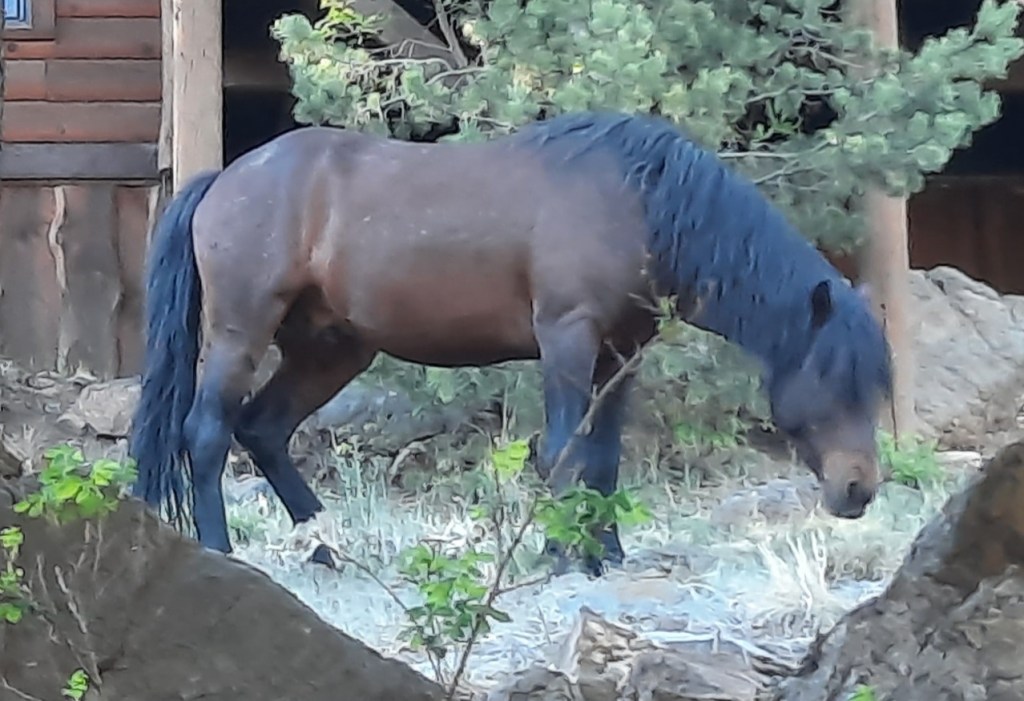
It hits me every time I go into Rural King. Or when I pass a barn with a riding arena, set up for rodeo or jumping—that familiar twinge of admiration and envy. It’s an agony of nostalgia if I encounter a trail rider and they are mounted and I’m on foot, hiking.

I miss who I was when I was a horse person.

I’m still a horse person. But not like I was. Not when I smelled every day of leather and horse sweat, when there’d by hay in my hair and baling twine in my back pocket.

I still have round pen panels in the garage. I have one remaining saddle, some brushes, a feed pan. I keep a lead rope in the truck.  There’s a hoof pick in my desk drawer in my office.

I go into the farm supply store to buy chicken feed, dog and cat food. I avoid the horse aisles.

I hate not buying fly spray and dewormer and supplements. I hate walking right past all those rows of horse halters and mineral blocks, hoof treatments and curry combs as if all of that never had anything to do with me. As if I never had anything to do with it.

I’ve been blessed with some amazing horses. Pat, the pony who was my first horse love. Beautiful, brilliant, fast Merlin, the horse of my heart and soul. Sweet Crocodile and Mythic the mischievous, Ghostbuster and my dear Joker. Caesar, the gentleman. Pantheon, the rescue I could never quite reach.
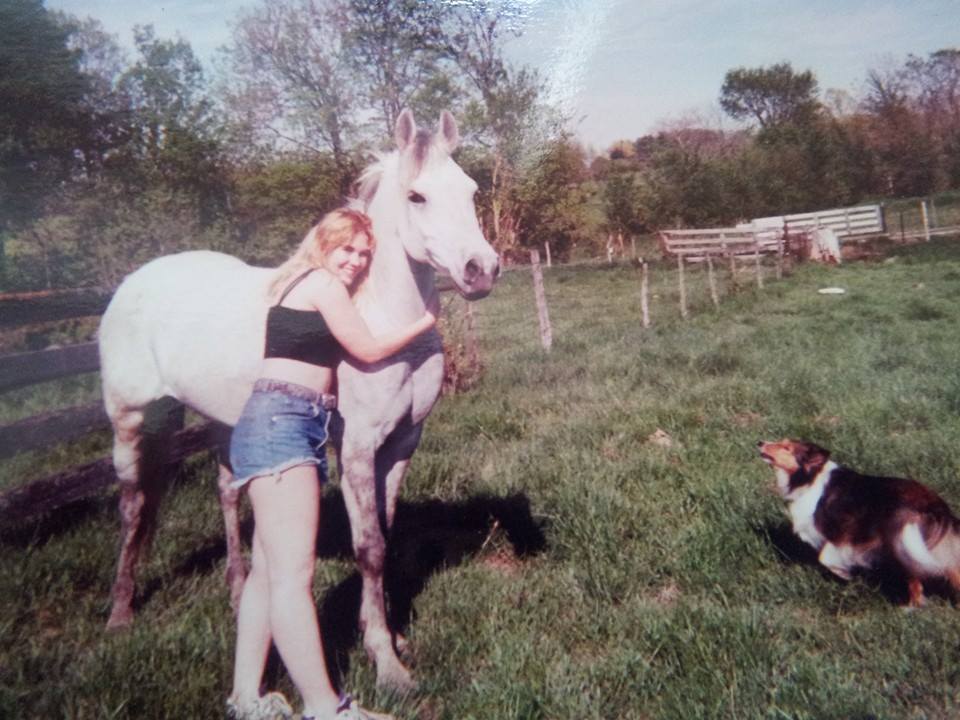
Merlin, my soul horse. And my dear little Robbie, a noble dog.

Since I was about 5 years old, I’ve said I was born loving horses. I said, “My real mom or dad must love horses.” It was a statement that reverberated within my adoptive family.

And as it turns out, it’s true.  

Ironic: I’ve found where I belong, and I’m not there right now.

I found my biological family, including my father, and I’ve ridden his wonderful mare, Keeper, and we can talk horses all night and all the next day, but my anecdotes are from years past.  There’s nothing new to tell him.

I’ll have horses again someday. I plan to, anyway. Right now, I’m focused on my career as a horror author, a teller of dark stories and flash fiction. I’m rewriting (again) my first novel, and I’ve got four more lined up right behind it.

Truth is, if I have a horse, I won’t write. It’s the time, sure, but more to the point, it’s that the angst pushing me to write evaporates in the presence of horses. I don’t have to do anything more than put my face against a neck, right where it meets the shoulder, or run my hand underneath a mane for everything in my world to tilt onto a more stable axis. (Pun intended.)

I feel like writing is what I’m supposed to be doing right now. Some days I’m sure of it, some days it’s cloudy.

As I write this—this reflection so often in my mind—I can see, from where I sit, the edge of what will someday be a pasture for a couple horses. I know that, if I had horses there now, I could walk outside, go to the gate, and they’d come with their nickers and their face rubs and all this angst would melt.

Instead, I’m holding onto it. I’m about to go back into the document labeled Version 11, with Outline 4, and see if I can tempt a future reader (you, maybe?) to fear the cold, dark water of a strip mine pit lake and the primal creature who swims there, not alone—a creature who misses the way things were before the diggers came. And a main character who is trying to hold onto who she is.
Yesterday I drove past a sad scene on my way home from work—a gray horse on the ground, a woman crouched near him stroking his neck, faithful dog by her side. I turned around and drove back, asked the woman if she was OK, expressed my sincere and teary-voiced sympathy when she confirmed the horse had died.

I’d noticed from the many times I’d passed his pasture he was a bit thin in the way of older horses, despite good grass, and, judging from the obvious health of the other horses, good care. Watching his owner sitting with him, comforting herself by waiting with him for her husband to arrive with the tractor to bury him, of course it put me in mind of the terrible day I lost Merlin.

That day is never far from my mind.

Merlin was my heart and soul horse, and a part of me died when he did. I don’t know if it was like that for this woman and her white horse. But clearly she’d lost a friend.

If you’re a horse person, you cherish that special bond. There’s nothing quite like working with a 1,000-pound animal and feeling a connection that makes you a team. It’s breathtaking when your horse, your friend, leaves the camaraderie of the herd to visit you at the gate. There’s no healing like that offered by a horse, and no view better than the one of scenery between a horse’s ears.

I’ve driven past this farm for five years now and this is the first time I’ve spoken with or even been near to anyone living there—me standing in the road, her about 20 yards away. And yet I have something in common with her, don’t I? Several things, in fact. Probably more, were we to sit and talk. Maybe she has kids and grandkids. Maybe she’s had some difficult family relationships, and some wonderful family surprises. Possibly she has conflicts at her job that make her work less satisfying than it could be, and perhaps she’s sometimes proud of an accomplishment that made someone else’s day better or easier.

Are you with me still? I’m going to ruin it now by talking about politics. I can tell from the signs in the yard—the banner on the horse barn, even—that we aren’t a match when it comes to politics. We may even have some serious disagreements. I’ve thought some fairly unkind things as I’ve driven by, and made some assumptions that probably aren’t completely off the mark.

Now, though, I’ve shared a grieving moment, however briefly, with at least one person there.

The sun didn’t break through the clouds just then, there were no rainbows, butterflies, musically chirping birds. I’m not going to call her up for coffee or even send a card. But I am going to remember she’s a child of God, as am I, and a person, not a caricature.

What I mean to say: It’s so easy to hate someone. Takes no effort at all. It’s equally easy to sit in judgement of other people, to assume the worst of everything about them. No special skills needed for that.

Horse people know: when you are riding a horse you can’t actually force that horse to your will. Oh, you can add training aids, some of them brutal. You can deprive a horse of its will to live and cow it into obedience. But if you want a partnership with a horse, if you want to get something done, you have to find a way to communicate and cooperate.

It’s true that some horses, like some people, are intractable—vicious, even. But most horse people know that in nearly every case, there’s a reason for the horse’s bad acting.

Not sure, but it seems like there might be a lesson here for me.

As much as I love wilderness areas, there is something undeniably satisfying about hay bales in the field. And round bales are so picturesque.

(Almost as good as hay in the barn, when I have horses. Though then I prefer square bales.)

Anyway, I love the smell of fresh hay. It’s like summer and fall all at once.

I took advantage of the last few round bales in our back field to do a quick place reading. It’s Too Late appears in The Molotov Cocktail, which was a goal publication for me. Extra-cool when it works out that way. Check out the yin-yang illustration that accompanies the story online!

The germ of that story was an incident that happened years ago, before I bought my first horse and had a partial-lease on a horse in Michigan. Dusty was a registered Paint, a tri-color buckskin paint. I went out to ride one afternoon as a storm was brewing, and the tension in the air, and the horses’ reactions to it, made me feel electric. But also, observant enough not to ride.

I called on that memory as I challenged myself to write something spooky about something I love.

I hope you enjoy!

I was a horse crazy kid. I will say, in fact, that I was born loving horses. I grew up on Walter Farley’s The Black Stallion series, and Marguerite Henry’s great books about horses in history. Like many horse crazy kids, I dreamed of taming a wild horse who would love and trust me and our inseparable bond would be legendary.

As my experience with real live horses grew, my expectations became more realistic. I gained a better appreciation for the hard work that goes into bond-building, the number of spills that occur along the way to improved riding and horsemanship, the unglamorous chores like stall cleaning, fence fixing and water hauling that are part of horse ownership.

And I also experienced the addictive magic of a forest gallop on a fast horse, the companionship of hanging out while horses graze nearby, the thrilling moment of perfect sync between horse and rider.

But despite all that, I never lost that romantic notion of a close, voluntary encounter with a wild horse.

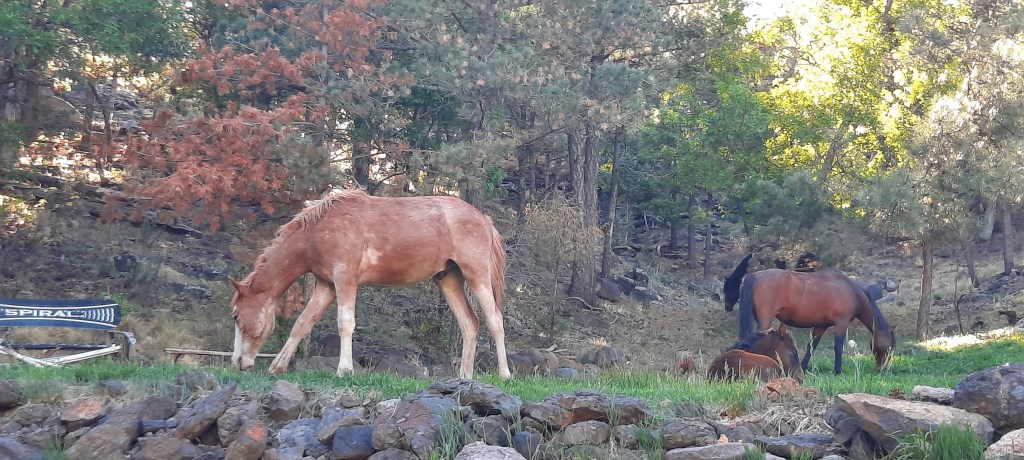
The wild horses around Ruidoso, New Mexico are a mixed lot of recently feral and born wild. They are accustomed to people. Like suburban deer, they don’t spook at the sight of people, they don’t worry too much about being in plain sight of a house… or a baseball diamond with a game on.

Still, though.

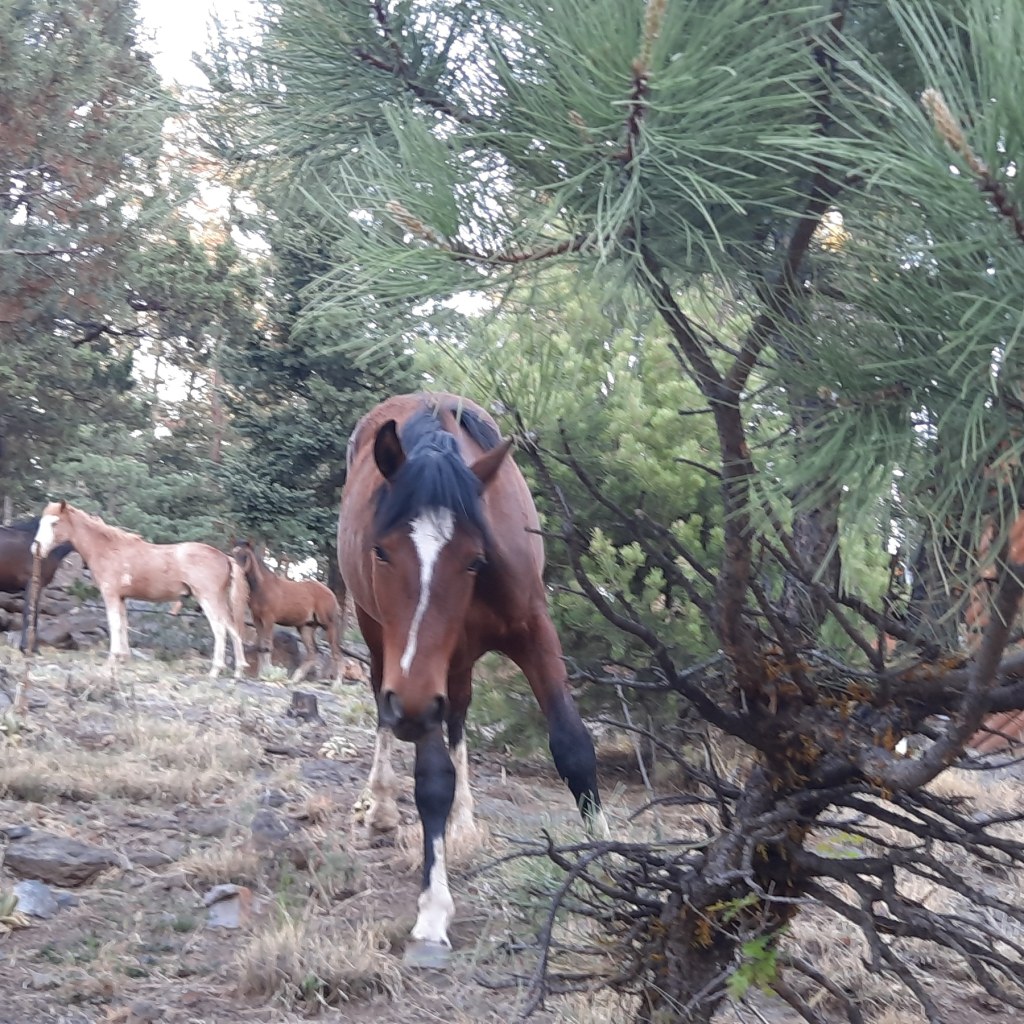
My first sight of the bay stallion’s Ruidoso herd had me breathless. As they were at the entrance of the mountain cabin community where we had our Air BnB, I got out of the car, assured my family they could go on without me when they were ready, and settled in to observe.

I had no intention of approaching. A bay mare was particularly curious and seemed to respond when I talked to her. I moved for a better view, and the horses came nearer. The bay mare was within 10 feet of me.

When they moved away toward our cabin, I chose a route that took me close to them but not directly in their path. I paused a few yards away, watching. A roan foal and a bay foal paired up to come closer to me – clearly expecting me to give them something. I reached out my hand and they nuzzled my palm, both of them – and a third foal that crept up during the encounter.

I told them I didn’t have anything, but if they followed me to the cabin, I had some carrots. I turned from them, rolling my shoulder in the horse person gesture of “follow me.” The little stinkers did!

When I was below our cabin, my partner Tim and our boys, Dylan and Will, were on the deck watching the whole thing. They tossed carrots down for me to feed the three foals and also the curious bay mare. I kept my eye on the stallion in case he didn’t like the situation. We had a moment when we regarded each other, and he decided I was no threat.

I confess I got a little bit weepy here and there during the encounter. The flash of understanding with the stallion, the friendliness of the mare, the frank curiosity of the foals – it was the sort of interaction I’ve had with horses plenty of times. But these guys were wild ones. Not mustangs, necessarily. But wild all the same.

Ah, Facebook, that entity we love to hate. I’m more in the hate to love it category, maybe. Facebook is the home of my writing community. It’s where I’ve “met” and gotten to know writers and horse people across the country and in several other countries. It’s especially fun when I get to know writers who also love horses. It’s a good combination, I think.

Doug Anderson is one of the most thoughtful people I’ve encountered through Facebook. I’ve read his posts about the state of the humanities, trigger warnings, cultural appropriation, culture, teaching, aging, love, memories of love, the need for love, the Vietnam War, and horses. His opinions are considered, not knee-jerk. And if he throws something out there as a question, you can be assured he’s already given it quite a bit of thought. Clearly I admire him.

He is also an award-winning poet. National Endowment for the Arts Fellowship, Pushcart Prize, Eric Mathieu King Fund of the Academy of American Poets – you know, big deal awards.

He was nice enough to answer some questions I had for him after reading his most recent poetry collection, “Horse Medicine.” I’m tempted to post these one question at a time because the answers are weighty. However, Doug sent me answers to my questions weeks ago and it’s about damn time I post them. No more delays! The world marches on, there’s never a “perfect” time.

Q: What do you think is the biggest challenge facing writers today?

A: Students are not being trained to read nuanced language in high school; they mostly get short non-fiction pieces. This is part of the teaching-to-the-test strategy. It has done incredible damage. Students arrive at college way behind and resent having to read texts that have any kind of difficulty, or lead them toward the discovery of their own imaginations. When I was an undergraduate I remember students carrying poetry books because poetry was a part of their world—even students in non-English majors. That’s all gone now and the reading of imaginative literature is now the province of an elite class. It is demonstrable that the reading of imaginative literature builds empathy. I’m resigning myself to the idea that I’m speaking to a very small tribe when I write.

Q: The pull of Vietnam for veterans of the Vietnam War seems to me to be different than, say, Afghanistan. What is it that brings the soldiers etc. back, and what do they carry home with them after they’ve returned during a time of peace?

A: Vietnam is an undigested mass on the country’s soul. Many vets ceased believing in the war, even when they were fighting it. There is a desire held by many of us to make friends with the country we devastated, make friends with our former enemies. I’ve been back twice since the war, and am a member and teaching affiliate of the Joiner Center for the Study of War and Its Social Consequences. We’ve made friends with many former soldiers who’ve become writers. This war will not go away until the country reckons with it. Or until all who fought in it are dead, and then it will enter a whitewashed history. BTW Afghanistan is not all that different than VN. It is a war of choice begun for corrupt reasons and going nowhere after over fifteen years. Afghanistan vets are beginning to ask questions.

Q: How has your poetry changed over the years?

A: When I began to write poetry about the war in the eighties I was fortunate to have Jack Gilbert as a mentor. The poems came fast and hard and I was able to shape them into a chapbook, and then a full-length book. I can say I really learned how to write poetry during that time. Poetry seemed to be the perfect medium for memory. Much of war is waiting, and then a sudden violent event. The brevity of poetry is right for that.

Q: What has horse medicine done for you?

A: For a few years I was associated with a horse rescue farm with 32 draft horses. I grew to love those horses. I did photography and publicity for the farm and hung out with the horses in the paddock. A horse is not a pet and the relationship one has with it is much more complex, involves changes to one’s nervous system and emotions. It is demonstrable that these relationships can be healing. The poems that came from this are celebratory.

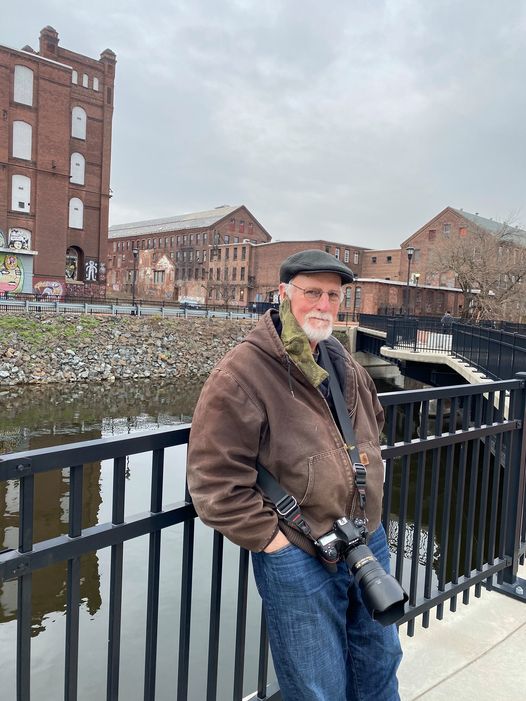
(Photo swiped from Doug’s Facebook page.)