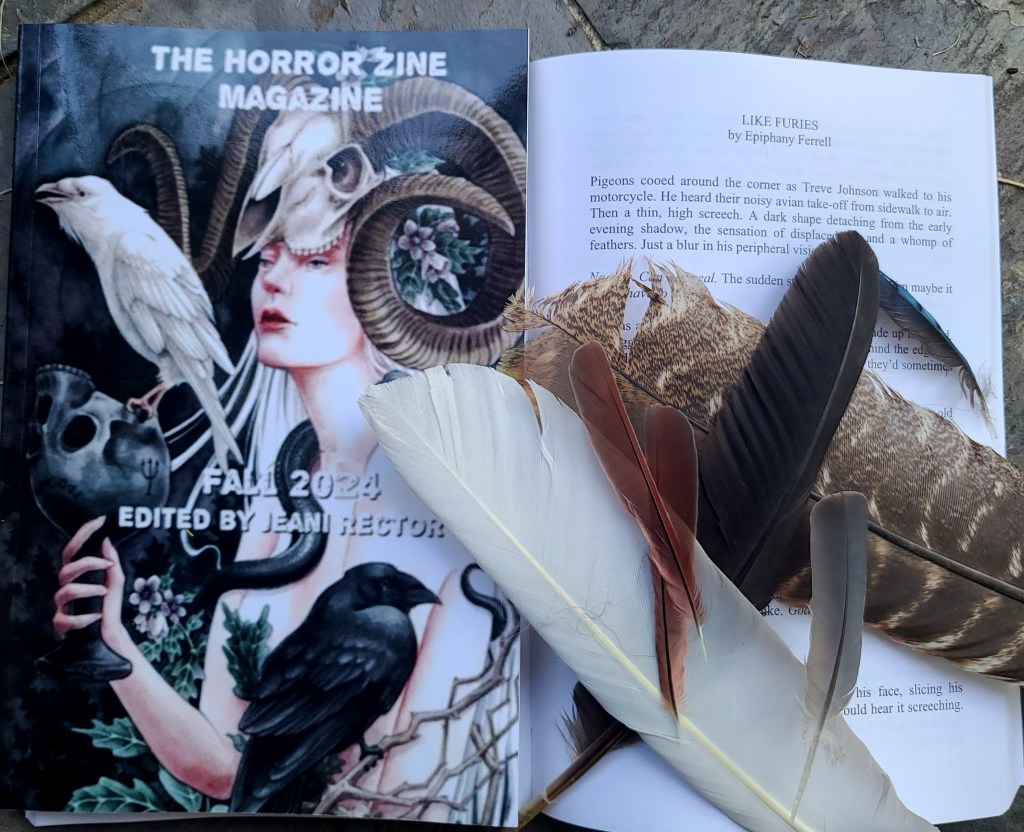
I’ve got a story in The Horror Zine Magazine! The Horror Zine has plenty of street cred in the horror world. It’s got longevity and quality on its side, and editor Jeani Rector is well known for her contributions to the community, including encouraging new horror writers.
I’m continually enchanted by the idea of the veil between the worlds stretching, growing thin, allowing crossover from one world to the next. It’s the essence of fairy stories. For me, it’s part of what moves me to awe in the natural world. And it’s often something I weave into stories.

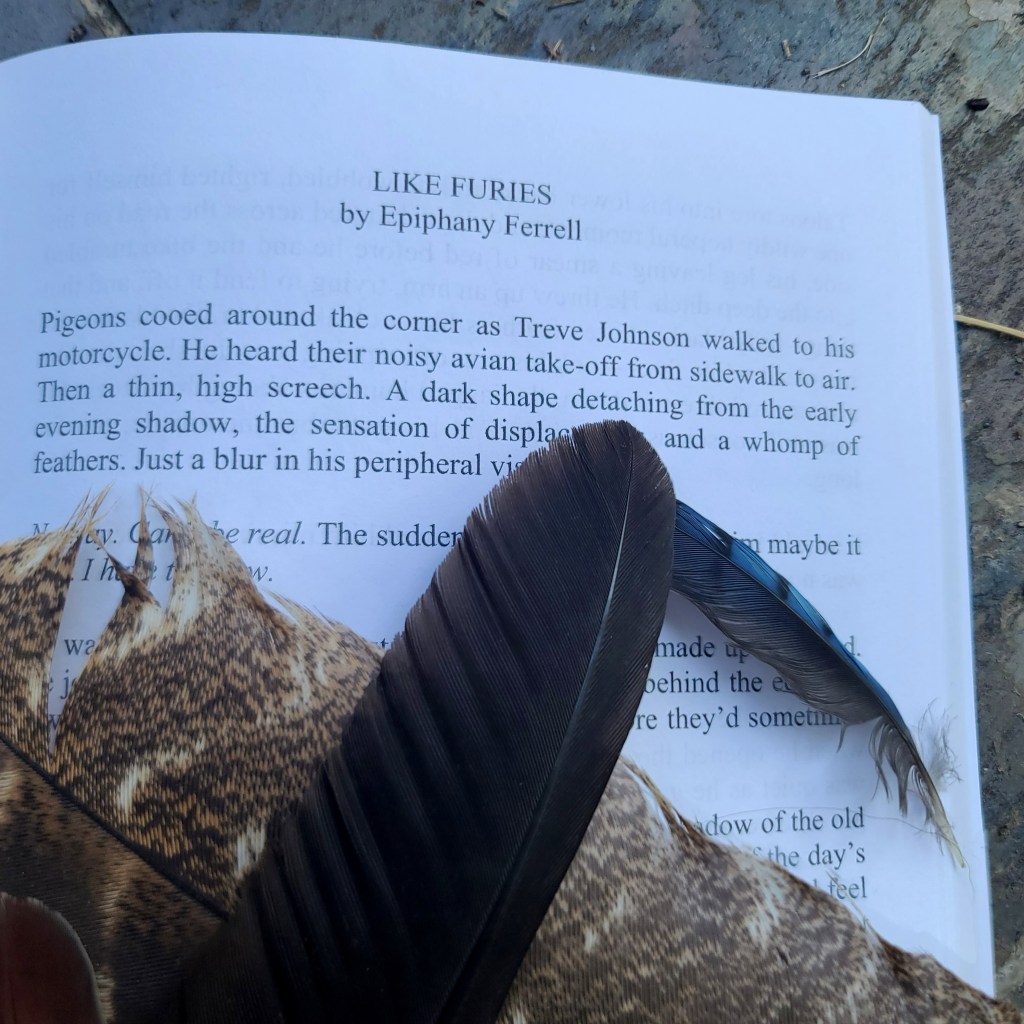
The idea for Like Furies came while I was waiting for my husband’s trio gig to start in Centralia, Illinois. They play in a courtyard between two older brick buildings. I was restless, and was walking around this block, then that one. We were on the edge of town, near railroad tracks. Within the same two block square, there was an abandoned building with tall grass and vine in the alley like a jungle, and also store fronts, a bank, park benches along the sidewalk, and a couple traffic lights. As I wandered around, I noticed a few feathers on the sidewalk. I almost always pick up feathers. A few feet further, more feathers, different kind, in good shape. As I walked, I picked up half a dozen nice feathers, and left quite a few on the sidewalk that were in poor shape, or clumped together as if torn out in a bunch.

And that got me thinking: Why are there so many feathers? A resident peregrine? Some larger cities have them to control the pigeon population. What if it was something else? Something sinister? That, in the way of small towns everywhere, no one would talk about? What if that person watching me pick up a feather didn’t think I was merely weird, but that I was breaking tabu?

I scribbled a few notes, and began writing the story the next day.
I thought about having someone send Tori to Black Creek as vengeance for an imagined slight. But as I wrote her character, it became clear she wouldn’t fall for that. She wouldn’t be a victim— she’d be more susceptible to grief. But not over a man.

Though I didn’t describe what she looks like in the story, I have a clear picture of her in my mind.

That’s the way it works for me. Sometimes characters are fully formed in my mind and they tell me what to do, being rather bossy about it. Other times, I have to tease it out. And sometimes I only know what they are all about until I’ve gotten it wrong a few times.

The story’s ending was a bit of a surprise for me. I had it in my mind up until Tori’s encounter with the source of the feathers in town. The rest was spontaneous. I love when that happens.

Print copy, with that outstanding cover art, here.
I grew up in a town where the Pied Piper was (is) a big deal. In fact, because of it, I was a rat in a parade.

My home town is Frankenmuth, Michigan, known as Michigan’s Little Bavaria. One of the town landmarks in the Glockenspiel at Bavarian Inn. The Glockenspiel is a 50-foot bell tower that plays music and tells the story, with the help of carved figures that emerge onto a platform, of the Pied Piper.

One year the kids in my neighborhood entered the annual Children’s Parade, part of the then-weeklong Bavarian Festival, with a Pied Piper rat group, and a Pied Piper child group, with two of the older boys playing the Pied Piper. So… I was a rat.

When I say I have always been fascinated by the darkness of the Pied Piper of Hameln story, I mean it.

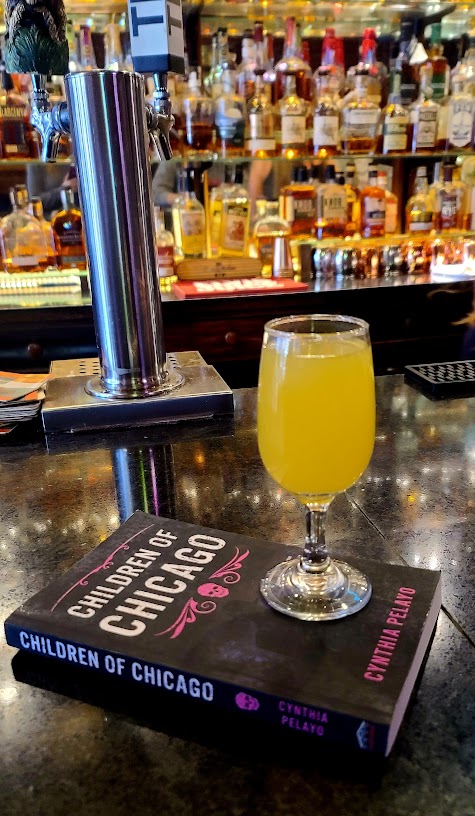
In Children of Chicago, Cynthia Pelayo took a dark tale and made it even darker, dark as pitch. In Pelayo’s hands, we have a Pied Piper that is truly the stuff of children’s legends, and the instrument of the kind of pure anger of which children can be capable. This is a story about children killing children. And somehow, it is told with compassion. Unflinchingly, but also with empathy. It’s a stunning accomplishment.

If you are familiar with the Pied Piper story, don’t think that will help you. This is a horror story with thriller overtones, and the mysterious twists and bends that come with a good detective mystery. You might think you have it figured out, and you might, partly. You won’t see the whole thing coming at you, I assure you.

Chicago is as much a character in this story as the children and the detective trying to save them. Calling it a love song to Chicago is trite. But still true. I’ve been to Chicago a dozen times, but I’ve never seen it presented in quite this loving, honest, respectful way. The next time I’m there, I’ll try to visit Humboldt Park. I won’t be chanting rhymes in front of candlelit mirrors, though. No way.

The drink is a mimosa. It was early-ish and I’d had … some beers… the previous night. The place is the Crazy Horse bar and grill in Bloomington, Indiana.

A trifecta of folk horror. I was reading The Only Good Indians by Stephen Graham Jones while I was at Archon 46, a sci-fi and fantasy event featuring writing hero Jonathan Maberry. Whom I got to meet. And to hand-deliver a bottle of local Chambourcin after alerting him to the presence of a wine trail here in Southern Illinois.

Back to the book. Holy shit. SGJ wrecks me. In a good way. But I will have to take a few deep breaths from now on before starting reading. The Only Good Indians is a wonderful example of what happens when someone breaks a rule pertaining to the Other world and doesn’t know it or doesn’t take it seriously. In this story, four young Blackfeet men know they broke a rule—they hunted elk in a section reserved for their elders. Ten years later, they begin to realize they did more than poach—they transgressed. They have made an enemy of Elk Woman. And her fury is implacable. Their (self) destruction is painful to witness, and the struggle of those around them to avoid becoming collateral damage is heart-rending.

I stopped in at the Old Herald Brewery & Distillery for lunch and an Oktoberfest. The building is the former offices and printing site of the Old Herald newspaper. This ex-reporter appreciates the theme, carried through as it is on some of the menu items.

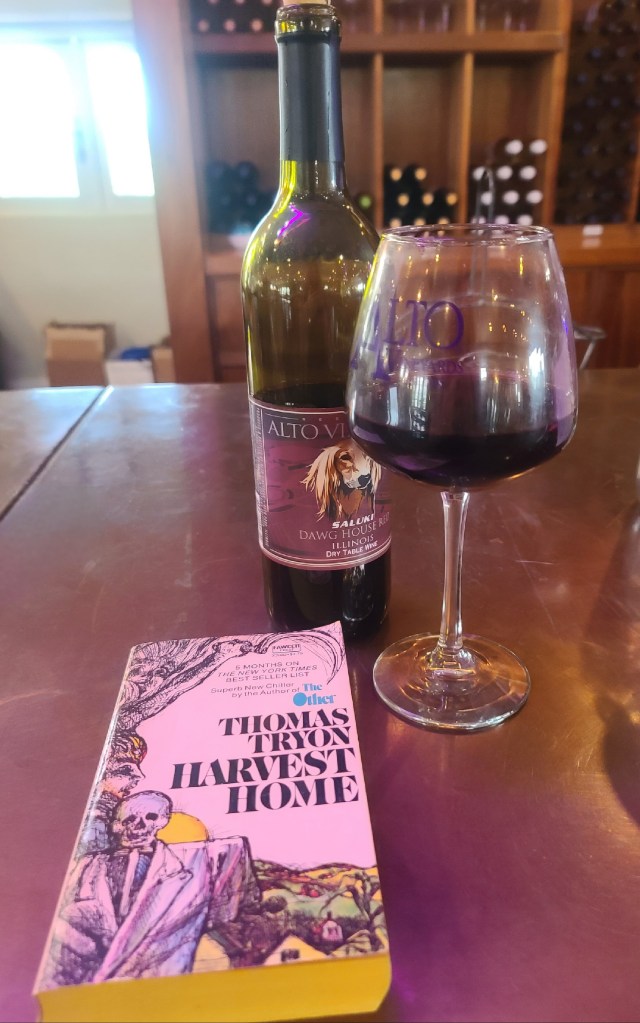
Harvest Home, by Thomas Tryon, makes just about every list of folk horror ever. I am late to the party, but can confirm—folk horror gold.

This is another one where the main character, Ned Constantine, knows he broke a rule. He fails to consider the consequences. Ned brings his wife and daughter to the quaint farming village of Cornwall Coombe, where they resolve to embrace country living and leave behind the pace and distractions of NYC. Ned counts befriends young malcontent, Worthy Pettinger. Ned begins to understand the nature of the strange pseudo-religious beliefs in the community, and the role of the Widow. Fearing for Worthy’s safety after the young man disappears, Ned determines to uncover the mystery. One great thing about this slow-build book is how the reader is constantly two or three steps ahead of Ned. You get the thrill of discovery as the plot unfolds, and the dread of watching Ned make mistake after mistake.

I was at Alto Vineyards for this one, drinking a Chambourcin blend, Dawg House Red. It should have been mead…

I just finished reading The Hunger by Alma Katsu. Katsu makes the horrific story of the Donner Party—the pioneers who resorted to cannibalism to survive after forced to winter in the mountains during their ill-advised shortcut to California—even more gruesome and terrifying. Blending folk tales and dread whispers from German settlers and Native Americans of several tribes, Katsu creates a threat that is monstrous, vicious, and horrifying when you realize what “the shadows” are and where they originate. While this book is clearly fiction, equally as clearly Katsu did plenty of research. It’s easy to lose yourself in this book, and to feel kinship with some of the characters.

I was at a nearby winery, Starview Vineyards, drinking Chambourcin, the same wine I brought to Archon. That oak tree you can see in the background is one of my favorite trees in the area, and is a true landmark.

Remember: read more horror. And share what you are reading!
#nerdinabarwithabook