There are anecdotes and incidents swirling around in my head that I know will one day end up in a story or novel but aren’t in and of themselves stories.

Here’s one. It has to do with clothes, but more with identity.

Many years ago, I was scrolling through the channels and came across a talk-show on which makeovers were to be featured. It might have been Dr. Phil. My imagination has certainly embroidered on the memory.

Here’s how I remember it.

There were four makeover subjects, all of whom had been suggested for the show by friends or family members who felt they needed significant change, like dressing younger or caring about their appearance. The fourth candidate was there because her high school-aged son wanted her to be less out there. One of her outfits the show highlighted to demonstrate her style was a bright red skin-tight leather bodysuit with sexy cutouts she’d worn to a parent-teacher conference or something school-related.

My writer voice immediately began filling in the blanks on this character. I’m going to call her Reba. She was clearly a young mother. I imagined she felt “If you are going to judge me, bitches, let me give you something to talk about!”

 I saw her as defensive but also fiercely proud that despite expectations, she was successfully raising her son. I would write her as someone who wasn’t able to get past her past—someone for whom every encounter was a chance to say, “You aren’t the boss of me!” From her son’s point of view, this defiance sometimes overrode his own needs. I could imagine him thinking, “Mom, this parent-teacher conference is about me, not about you.”

The other three make-overs were reasonable. Reba’s makeover? Think the Ally Sheedy makeover in The Breakfast Club.

They cut Reba’s hair. Isn’t that the first step in controlling any wild woman—tame her hair? Her new ‘do was safe and boring. For her clothes, they selected a dowdy suit (at least it was purple) appropriate for someone twice her age.

She was obliterated. The make-over team had a vision of her that was insulting to her individuality, and seemed designed to tell her that everything about her was wrong—that she was the opposite of how she saw herself.

I was so pissed off about it I thought about writing to the show. Could not the flunky makeover team find tailored leather slacks, a silk blouse, a suede jacket with a touch of fringe? Something fierce and edgy but more growl than a full-on howl?

But wait, it gets worse. She started to cry. The host was disconcerted and immediately sought to soothe. “What’s wrong?” he asked.

Her son—blandly clean-cut but seemed like an okay kid—piped up to say, “You cut her hair, that’s why she’s upset.”

“No,” she said. “It’s because of you. You want me to change who I am, to be someone else. I can’t be this person.”

I wonder to this day what happened to the mother-son relationship after they went home. I hope they were able to talk to each other, for the son to communicate that he felt overshadowed, and that she was able to explain her hard edge.

If I were writing their story, though, she might double-down, show her son the same perpetual middle finger she showed the rest of the world.

The Devil in the Details: Part 2

When writers read, we take notes whether we mean to or not.

I’ve read descriptions of a character’s wardrobe that pushed me all the way out of the story. Too long, too much! I’ve also read clothing descriptions that rounded out a character.

A great example of the latter is author Laura Benedict, in one of her earliest novels, Isabella Moon. (Watch the badass book trailer!) She describes protagonist Kate as wearing a “paper-thin sweater.” I knew exactly what she was referring to, having purchased just such a sweater at a thrift store. I knew approximately the sweater’s price new, and how a person who did not shop at thrift stores might style it. That tiny detail enhanced Kate’s description so well, I understood, in a whole new way, how she fit in with the other characters.

I’m rewriting my own first novel (again) and trying hard to use fewer details to carry more weight. I know my characters down to what they’ll sing along to in the car when alone, but too many specifics bog down the story.

Wish me luck, that I find my own paper-thin sweater moments!
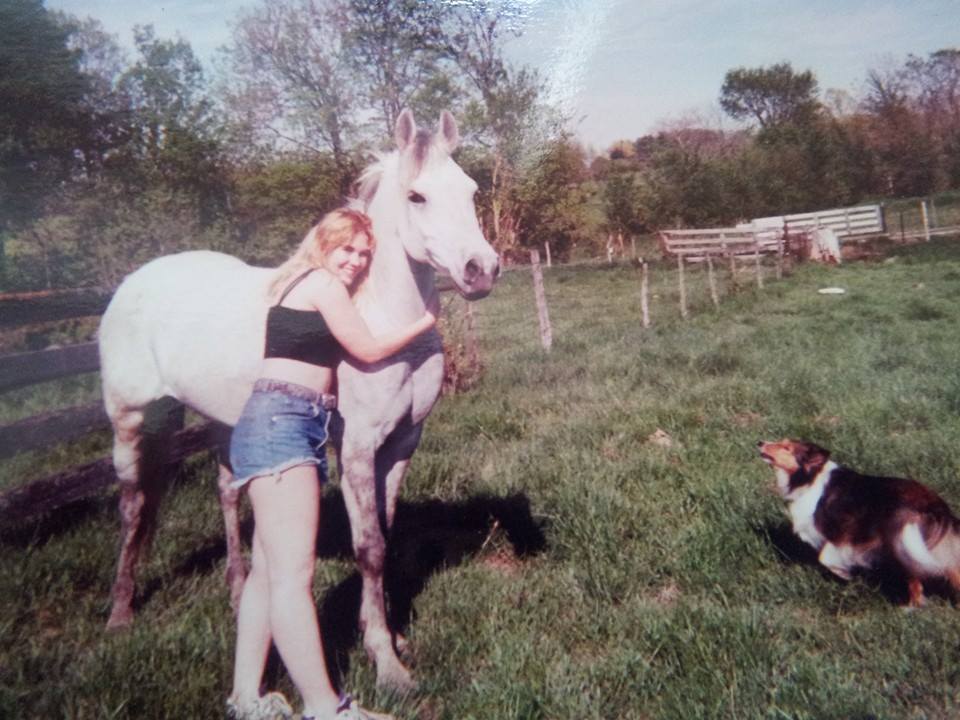
It hits me every time I go into Rural King. Or when I pass a barn with a riding arena, set up for rodeo or jumping—that familiar twinge of admiration and envy. It’s an agony of nostalgia if I encounter a trail rider and they are mounted and I’m on foot, hiking.

I miss who I was when I was a horse person.

I’m still a horse person. But not like I was. Not when I smelled every day of leather and horse sweat, when there’d by hay in my hair and baling twine in my back pocket.

I still have round pen panels in the garage. I have one remaining saddle, some brushes, a feed pan. I keep a lead rope in the truck.  There’s a hoof pick in my desk drawer in my office.

I go into the farm supply store to buy chicken feed, dog and cat food. I avoid the horse aisles.

I hate not buying fly spray and dewormer and supplements. I hate walking right past all those rows of horse halters and mineral blocks, hoof treatments and curry combs as if all of that never had anything to do with me. As if I never had anything to do with it.

I’ve been blessed with some amazing horses. Pat, the pony who was my first horse love. Beautiful, brilliant, fast Merlin, the horse of my heart and soul. Sweet Crocodile and Mythic the mischievous, Ghostbuster and my dear Joker. Caesar, the gentleman. Pantheon, the rescue I could never quite reach.

Merlin, my soul horse. And my dear little Robbie, a noble dog.

Since I was about 5 years old, I’ve said I was born loving horses. I said, “My real mom or dad must love horses.” It was a statement that reverberated within my adoptive family.

And as it turns out, it’s true.  

Ironic: I’ve found where I belong, and I’m not there right now.

I found my biological family, including my father, and I’ve ridden his wonderful mare, Keeper, and we can talk horses all night and all the next day, but my anecdotes are from years past.  There’s nothing new to tell him.

I’ll have horses again someday. I plan to, anyway. Right now, I’m focused on my career as a horror author, a teller of dark stories and flash fiction. I’m rewriting (again) my first novel, and I’ve got four more lined up right behind it.

Truth is, if I have a horse, I won’t write. It’s the time, sure, but more to the point, it’s that the angst pushing me to write evaporates in the presence of horses. I don’t have to do anything more than put my face against a neck, right where it meets the shoulder, or run my hand underneath a mane for everything in my world to tilt onto a more stable axis. (Pun intended.)

I feel like writing is what I’m supposed to be doing right now. Some days I’m sure of it, some days it’s cloudy.

As I write this—this reflection so often in my mind—I can see, from where I sit, the edge of what will someday be a pasture for a couple horses. I know that, if I had horses there now, I could walk outside, go to the gate, and they’d come with their nickers and their face rubs and all this angst would melt.

Instead, I’m holding onto it. I’m about to go back into the document labeled Version 11, with Outline 4, and see if I can tempt a future reader (you, maybe?) to fear the cold, dark water of a strip mine pit lake and the primal creature who swims there, not alone—a creature who misses the way things were before the diggers came. And a main character who is trying to hold onto who she is.

I’ll have a story in it!! My story Like Furies will appear in The Best Horror of the Year, Volume 17, edited by Ellen Datlow!

Every year I look forward to this volume. It’s more than an anthology—it’s a State of the Genre address. I hoped someday to get a mention in it. I am honored to the core to be part of the actual table of contents!

Ellen’s approach to compiling this book is a demonstration of the strength of this horror community. It’d be easy to fill the anthology entirely with known names—and there are plenty of them, including authors from whom I have multiple books on my shelves—but that’s not what Ellen does. She routinely selects several authors she hasn’t published previously (like me). This willingness to find and support authors and artists not already established in the horror world is one of the reasons the entire horror genre is currently experiencing a Golden Age. It’s not a closed club. It truly is a community open to new voices as well as supporting the leaders of the genre and honoring its founders.

Thank you, Jeani Rector, for first publishing this story in The Horror Zine—and not just for publishing it but also for taking the time to work with me to make it better. You know it’s a good edit when you see the suggestion and think “Why didn’t I notice that?” Her advice and know-how made this story so much stronger!

Thank you JG Faherty, my Horror Writers Association mentor. I signed up for the mentorship program with three goals: qualitative, quantitative and aspirational. JG helped me reach all three—and he continues to mentor me. He also read and commented on Like Furies and, as always, his suggestions were spot-on. After the first draft, before I let anyone else read it, I went through it and thought to myself, What will JG say about this?” And I made some deep changes to the story right there. That was part of meeting goal 1: helping me learn to edit and analyze specifically my horror writing with confidence.

Goal 2, quantitative: I made a professional sale to James Aquilone with a story appearing in the Stoker-nominated anthology Shakespeare Unleashed.

This was my aspirational goal—to write something Ellen Datlow wanted to see.

I’ll be pre-ordering 10 copies… or more… I hope you’ll get one too! Tell your bookstore to stock it when it’s available. And don’t worry, I’ll remind you!

Tonight is the last of a three-night performance of Epiphanies: performances of flash fiction. My flash fiction.

After the opening night performance, standing with my husband and friends at our favorite watering hole, the elation making me incoherent, I must have said “Wow,” at least 50 times. My face hurt from smiling.

The cast and directors: Back row, l to r: T Brown, Craig Gingrich-Philbrook, Epiphany Ferrell, Shelby Swafford, Mario Sanders, Christina Ivey. Front row, l to r: Paula Horton, Alicia Utecht, Sky Bartnick, Juno Blue, Elise Wheaton.

Let me describe this experience. Several weeks ago, I met my friend, Craig Gingrich-Philbrook, Professor of Communication Studies at Southern Illinois University Carbondale, to hand over a thumb drive with most of my published flash fiction—nearly a hundred stories, a jumble of word documents.

Craig presented these stories to a selected group of performance students—both undergraduate and graduate—and faculty. They chose stories to stage at SIU’s Marion Kleinau Theatre, a small stage best suited for intimate audiences and minimalist or experimental productions.

I arrived at the theater with my husband, singer-songwriter Tim Crosby, early. I was nervous, excited. Surrounded by a large group of friends, we sat second row center facing a black-floored, black-walled-and-curtained stage upon which rested a single prop—a simple chair/stair of black-painted wood.  

A graduate student introduced the night, and delivered the first performance. I was transfixed for that and the next 12 performance, 13 total.

Most were solos. One had two performers. The final performance included the whole cast of eight. By performance I mean a memorized reading that is also an acted interpretation of the story, making use of the stage but with only the prop of the chair/stair and another just like it.

They chose snarky stories and sad stories, stories that are darkly funny or tragicomic or wearily bitter. They infused each story with a multiplicity of emotion. One story was performed three times, which is an amazing way to understand the subtle differences in interpretation.

Around me, I heard my friends and audience reacting to my words and to their dramatic presentation. I felt seen. I felt my stories hitting home, doing what I wanted them to do, expressing what I wanted to say.

And, I heard my words in a whole new context, delivered sometimes the way I’d heard them in my head when I wrote them, and sometimes with a different shade of emotion that gave the story new meaning to me, its writer.

After the performance, talking with the cast, one of the words I heard most often from them was “fun.” They had fun with my stories! Can there be a better compliment than that?

My friends told me they had fun, too. And that they laughed, teared up, and were blown away by the performance.

I’m at a loss how to describe fully how this feels. I’m honored, obviously. It’s such a gift to have someone I respect as much as Craig ask to use my work in this way, to have a group of performance art professionals and students inhabit the stories, and to have my friends and members of the community come to experience it.

I have tried to come up with a philosophical statement about why I write. I struggle to explain it. Mostly, it’s something I have to do. I’m unhappy when not writing regularly, restless and snappy and bored. When I’m writing, even when it’s not going well, I feel like I’m doing what I’m supposed to do. Supposed to do why? I don’t know.

Early in my life I realized the emotional reaction I had to a story meant I shared something with the writer, something deep, personal and spiritual in a way—something that cut across time and geography. It’s one of the best feelings I know to read a story and to feel kinship with the creator, no matter what era in history or part of the world that person or people lived. I’ve wanted to be part of that timeless conversation since childhood, and as a writer, hope to do that.

This performance affirmed for me that I am doing it. That my words contributed to someone else’s artistic expression, and that the words separately and as part of the performance, touched people.

Thank you, Craig, and Shelby Swafford, Alicia Utecht, T Brown, Christine Ivey, Elise Wheaton, Sky Bartnick, Paula Horton, Mario Sanders, Juno Blue, and technical crew. You’ve given me a gift I will carry in my heart and soul forever.

I’m starting out the year with a few anthologies I’ve been pretty anxious to read. I’ll read simultaneous with novels and other books.

Weird Tales: 100 Years of Weird, edited by Jonathan Maberry, is going to be great. I became a Weird Tales fan in the late 1980s, when Weird Tales was part of Terminus Publishing and under the helm of George H. Scithers, John Gregory Betancourt, and Darrell Schweitzer. The magazine covers were beautiful and lavish, and I can see some of the illustrations with my eyes closed. Weird Tales in that era introduced me to some of the best writers in horror at that time. I can’t wait to dive into this 100 year retrospective and forecast, edited by Jonathan Maberry, who is absolutely a perfect choice for this. (He’s also the editor of the current iteration of the magazine.

I brought the book with me to Route 51 Brewery, where I enjoyed a Pumpkin Ale, easily the best of its kind in the region.

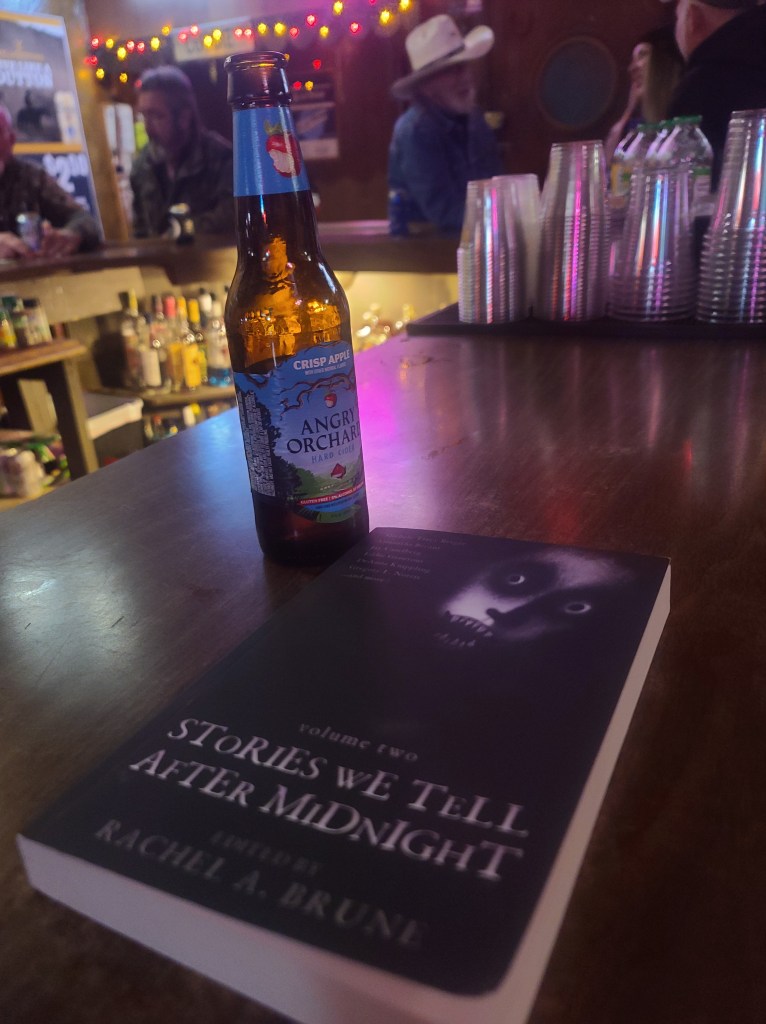
I just finished Stories We Tell After Midnight, vol. 2 edited by Rachel A. Brune. I’ll have to get volume 1 now. It’s a Crone Girls Press publication. Support indie horror publishers and get this book! Seriously, the founders are terrific people who were very welcoming to me at my first horror con. After-midnight nightclubs, nursery rhymes gone awry, dating while cannibalistic, becoming part of an all-too-real movie premiere—and more.

I had this book with me just after Christmas at my favorite dive bar in Union County, Fuzzy’s, while starting out the night with an Angry Orchard.

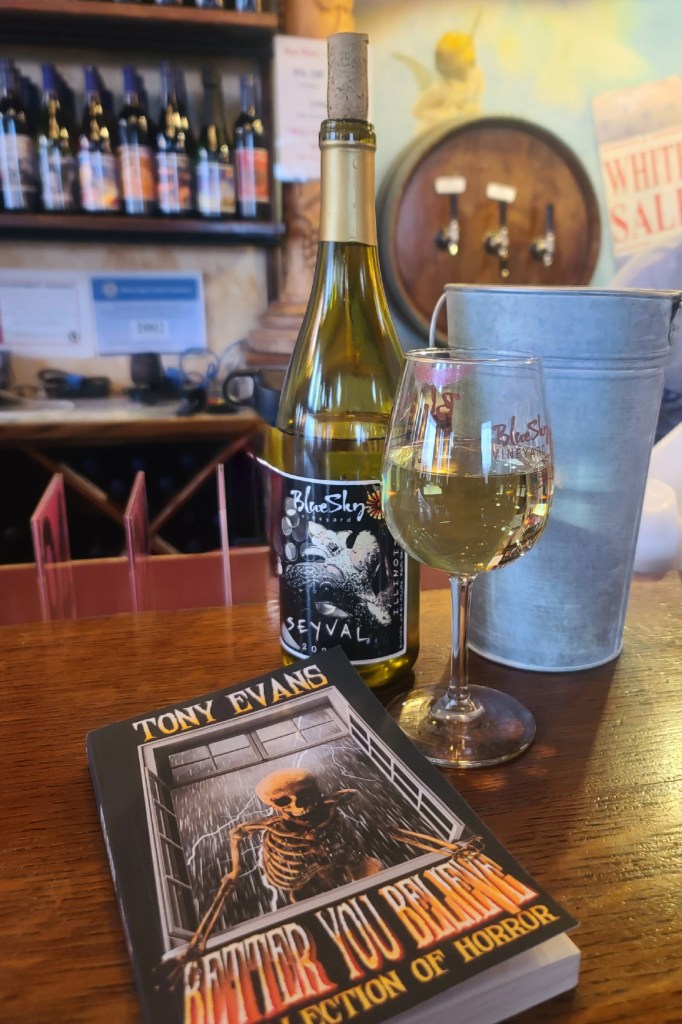
I’m a little bit fixated on the Appalachians right now. I’m always low-key into that region but driving through a corner of it on the way home from Scares That Care / AuthorCon last spring poured fuel on the Appalachian-love fire. So I’m ready to tear into Tony Evans’ Better You Believe: A Collection of Horror. Also, I plan to attend AuthorCon IV in St. Louis in October. I don’t have a book yet, but I will have a manuscript by then, I hope.

I started reading this one at Blue Sky Vineyard, where my wine of choice that day was Seyval.

Read horror! Share your #nerdinabarwithabook!