Caution: spoilers.

I hated reading The Girl Next Door by Jack Ketchum. I did not enjoy it at all. If Ketchum were not the craftsman he is, I’m not sure I could have finished it. As it is, he is an astonishing writer and he knew exactly what he was doing with this book. And it’s an important book, and, I think, one that should be read, and talked about. The back description sums up why: “Based on a true story, this shocking novel reveals the depravity of which we are all capable.”

Based on a true story. The novel is a fictional take on the true story of the horrible abuse and murder of Indiana teenager Sylvia Likens. Sylvia was abused, imprisoned, and eventually killed by Gertrude Baniszewski, whom Sylvia’s father trusted with her care. Baniszewski involved a handful of neighborhood children and her own children—Sylvia’s peers—encouraging their participation in inflicting serious injuries on Sylvia. Several adults in the neighborhood saw hints of maltreatment but none of them called authorities. The abuse escalated to shocking degrees, and eventually, Sylvia’s murder.

Knowing this book is based on a true story makes it that much more difficult to read. Because unlike two similar difficult-to-read-but-masterful books—American Psycho by Bret Easton Ellis and Not Forever, But For Now by Chuck Palahniuk—this is not a satire. It’s an exposé.

Ketchum’s book takes a hard look at the questions: How could this happen? Why did it happen? By his own admission, he flinched. In the book, main character David is redeemable, and Meg (the fictional version of Sylvia) has some small comfort at the end—she is not alone.

The depravity of which we are all capable. Several of the villains in this book are kids. The youngest is 10, the others in their early teens. However, their youth does not render them inculpable.

Ketchum makes David, neighbor boy and family friend, our protagonist. In doing so, he takes away our easy out—letting the kids off the hook and blaming only Ruth. David knows his limited participation is wrong, and he understands that his passivity is tantamount to betrayal. He approaches his parents when the abuse begins to escalate, but does such a poor job of explaining what is happening—and his parents such a lousy job of listening to him—that it amounts to having done nothing.

We are not to walk away from this book thinking, aw, he’s just a kid. We are to see ourselves as David. We are challenged to confront our own hesitation to take a stand when it’s difficult to do so, when we feel (or are) powerless, and when we might lose standing in our peer group—including in our careers or at university, for example.

Ketchum’s Ruth, the fictional Baniszewski, has had a rough and unfair life, and she has lost her ability to empathize. She convinces herself, at least in the beginning, that she’s helping Meg avoid some of the perils to which she herself fell prey. She is as hateful as any character I’ve ever encountered in literature.

While we might be very unlike Ruth, still: How many times have we justified being unkind, callous, or thoughtless because we perceive someone else’s suffering as less than our own?

Have we gloried in someone’s misfortune because we think they deserve it?

Have we labeled a group of people—those who vote differently than we do, for example, or those who choose different lifestyles—and by labeling them, rendered them less than human, a group we can denigrate and even persecute?

An important point to bring away from this book: Don’t assume you can never be the monster.

“We had permission.” A key factor both in the fictional and the true stories: The neighborhood children participated in torturing a girl because they were told they could. They had permission. An authority figure told them it was their right. They felt justified. They felt righteous. They might as well have confidently stated that they were “on the right side of history.”

So here’s another point: We can’t be like children and assume that authority is always right. “I was just following orders” didn’t keep war criminals from punishment. “They told me it was the right thing to do” doesn’t absolve us from asking questions. We have an obligation to defy authority when authority acts to persecute, vilify, and dehumanize. And no, it’s not just those people over there who need this lesson. It’s us, too. Whoever your “us” includes.

I needed some comfort while I was reading, some support. I posted about this reading experience in the Facebook group Books of Horror—an excellent community of well-read fans of the horror genre. The responses were thoughtful and considered. Other readers talked about feeling complicit in the atrocity just by continuing to read about it. They talked about honoring the memory of Sylvia Likens by reading the fictional account of what happened to her—giving her a voice and seeing her. A few people didn’t finish the book. A few people did and were still shaken. Very few were untouched by it.

This isn’t a book I’m going to be giving away at Christmas. It’s a difficult read. In writing this book, Jack Ketchum reminds us: We must confront the potential monsters we carry inside ourselves.

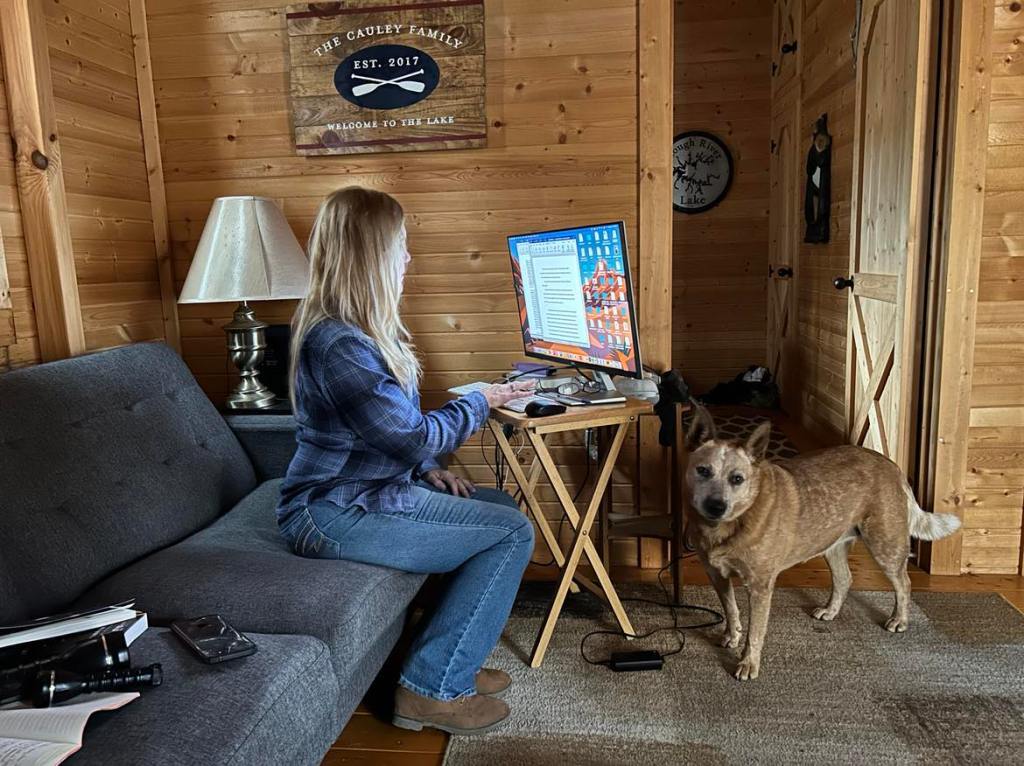
I hit 50,000 words yesterday, a whole two days before deadline. And for me, it is an accomplishment. I started writing a novel several years ago, and have set it down several times. I signed up for NaNoWriMo (National Novel Writing Month) for the first time as a do-or-die—finish a draft of the novel, or forget about it.

So I went for it. I did not write every day, but I did write consistently. The novel is not finished. There are probably 10 more chapters to go. My notes for the second draft are extensive. There are many fixes I’ll need to make—time inconsistencies, point of view and tense departures, plot developments that need foreshadowing, and pacing—my biggest challenge.

The end is in sight. I see a path to the end of the novel, and I’ve already got the scaffolding for the fixes. I’m all kinds of insecure about it. But also hopeful.

In addition to the formal NaNoWriMo, I was participating (trying to) in a 300-word story NaWriMo challenge. That kind of writing is so dear to me. With the novel, I’ve got a detailed outline that I update after each chapter and where I’ve made my story-fix notes; a character list; and a time-line with details that won’t necessarily make it into the story.

I write flash mostly from prompts: word prompts are my favorite, picture prompts next. Sometimes an open-ended suggested direction is helpful. But a prompt that says “Write a story about X leaving Y and encountering Z” is way too specific for me most times.

Once in a while I have an idea when I sit down to write flash, but most of the time I haven’t a clue. It’s an exploration, an adventure. I may write myself into a hole and back out again, and find the beginning of the story somewhere in the middle. Or, occasionally, the story explodes in about the second sentence, blooming into something I know I want to keep. Often, I write myself off a cliff and know there are no survivors—not a single sentence or phrase or image.

Writing every day for 30 days is a worthy aspiration. NaNoWriMo is like a detox cleanse, boot camp, sweat lodge, a period of fasting, training for a marathon—in short: a time set aside for a disciplined, rigorous attack on your goals.

I knew I wouldn’t be able to write every day when I signed up for NaNoWriMo—there are other areas of my life that require my attention. I’m sure a 30-day stretch with no misses is hard for many writers. Writing consistently, though—that’s crucial. Writing has to be part of your normal routine. If it is, then those times when you must take a break—for whatever reason—your good writing habits stay with you, and it will be easier to get back on course when you can. If you’ve never been on course… well… it gets easier and easier not to write. That’s where I was with the novel. The 30 days of focus on it has given me the determination to finish.

Thanks for hanging out with me, and for all the encouragement so many people have given me over the years. I hope to make 2024 my best year yet!

JG Faherty was my mentor during a formal mentorship with the Horror Writers
Association. And remains a mentor even now that the formal part is over. It is
not an exaggeration to say he revolutionized my horror writing.

I’ve wanted to write horror as long as I’ve wanted to write. I admire people
who started in horror and succeeded. I had to grow into it. I found my voice in
flash fiction—a genre I adore. My mentor in that realm is Meg Pokrass. I have
this idea that some day, future college students will study the Meg Pokrass
school of flash fiction writing. If I could warrant a footnote, that’d be
grand.

Faherty did that for me with horror. He gave me the roadmap I needed to be
able to analyze my own work. That is no small thing. To read your story and
know if it is on track or not is huge. I’m not an expert on my own horror
writing yet. But he booted me far down the road—farther than I could ever have
gotten on my own.

So anyway, yeah, I’m a fan. His recent book Sins
of the Fathers
gave me fucked-up nightmares. (Especially because they
combined with Stephen Graham Jones’ The
Mongrels
.)

I don’t read enough poetry. Occasionally a poem will kick my ass all the way
around the block. So I’m trying to read more. So when Faherty came out with a
book of poetry, I was all about it. So I had some fun with it.

A reading in a sculpture garden at Southern Illinois University Carbondale. And an unflattering still.

And here’s a review:

If you read JG Faherty, you know he’s not afraid to go there. Where? There,
man. Beyond the sane, normal, safe. He’ll go there. In a novel, that’s spread
out over a couple hundred pages. So, take that (razor-wire) edge and condense
it into poetry and you get Songs
in the Key of Death
.
These poems are dark as a cloudy night sky with
no moon. And they are bleak, or funny, or sly, or gory—all at once. I haven’t
had this much fun reading poetry since… ever? These poems range from cosmic
horror and aliens to slashers, serial killers, and sci-fi. The language is
rumbly and strong, crashing around like giant-thrown boulders or trickling
along like blood from a deep, non-arterial cut. They beg to be read aloud. But
if you do that, stay in the salt circle—please!
Enjoy!

I find that a couple nights away from home with the intention of writing like crazy, works. Partly because I go there with the express intention of writing. Partly because we are paying for it, so feel the need to get the most out of it. Or maybe especially because I rarely indulge in a writing retreat. In fact, this was only my second one ever!

So. Tim and I went to Falls of Rough, Kentucky, on the Rough River Lake. I had about a dozen places picked, and ultimately we went with the cheapest. (Heh) My selection criteria were: a place to write, a place with some privacy for Tim to work on a song, a place to walk, affordable, food options.

We got most of those in Falls in Rough.

I want a place for a writing retreat that is cool—but not too cool. In other words, a place I enjoy visiting. But not somewhere that makes me want to go outside and play more than write.

We stayed in a wee little log cabin in a lake neighborhood. I filmed a story reading in the loft—you’ll see it here later. The weather was pleasant for November, so Tim did a lot of his work in the fantastic gazebo on the property. We brought the dogs along, and they hung out on the porch, in the fenced backyard, or underfoot.

Sundance insists on looking out the front window. Banjo is content to curl up and chill out.

For my writing area? I wound up using a TV tray for a desk. Not even kidding. And I took my computer, not a laptop (my Chromebook is my laptop). So I was all cramped, not even able to use the mouse properly, hunched over and sitting on a couch in a corner of the living room.

It was great. I mean it. I got so much done!

I signed up for NaNoWriMo with what I called a new project, but which is only partly that. So what I was able to do on this writing retreat was to get all the way through what I already had, doing some small re-writes, and making notes of continuity problems, timeline issues, sucky sections, and character inconsistencies. I have a LOT of work to do on this novel. But right now the important thing is to finish the draft.

I wrote a trio of flash stories while I was there, too. One of them shall not see the light of day. The other two have some potential.

When we weren’t writing songs and stories, we explored the area. The nearest actual town is Leitchfield, and we went there, mostly, to eat. A highlight of the trip was me peering in restaurant windows that first night to try to guess if we’d be able to get a beer or other adult beverage with our meal.

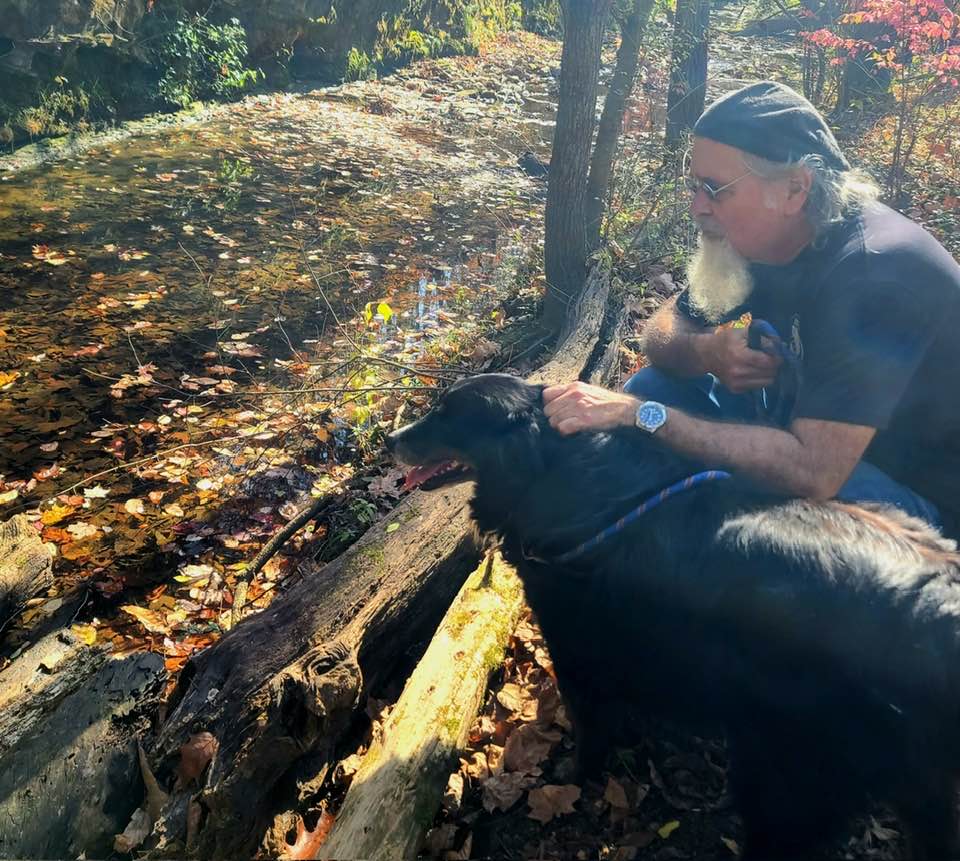
Tim and Banjo check out the fishies in the creek.

We hiked about 2 miles on the Taylor Fork Trail and area near it in Leitchfield. The park is in city limits, but the trail follows a creek and boasts some modest bluffs and rock formations, and the creek itself is pretty. There’s a spring-fed waterfall at the end of it—the dogs liked that part, and the creek crossings.

Home again now.

Got to keep that momentum going!

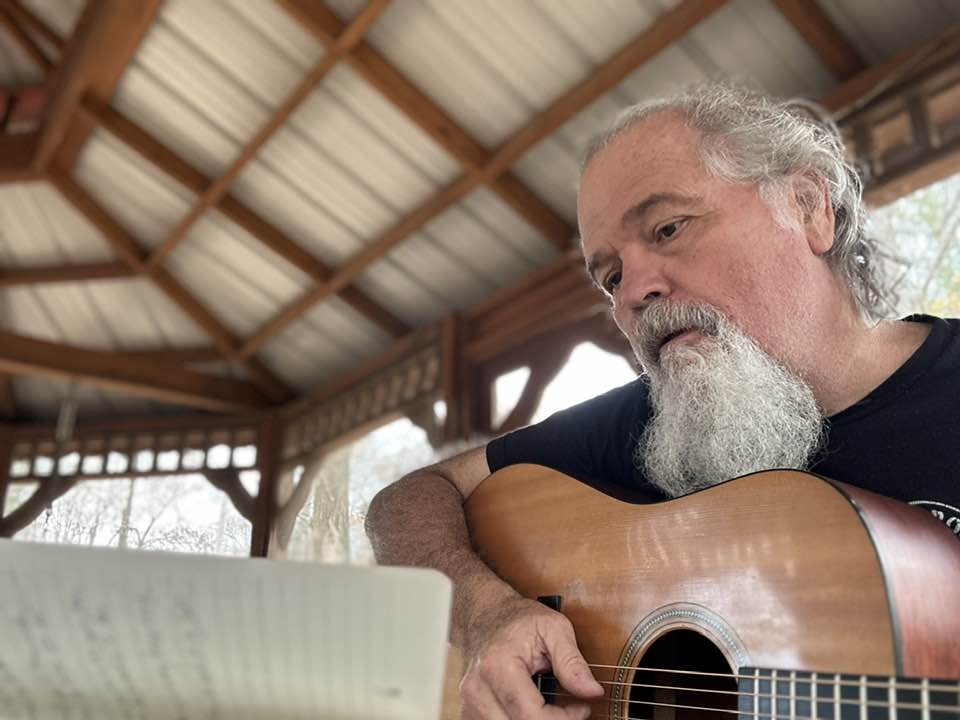
Tim working on a song in the gazebo.
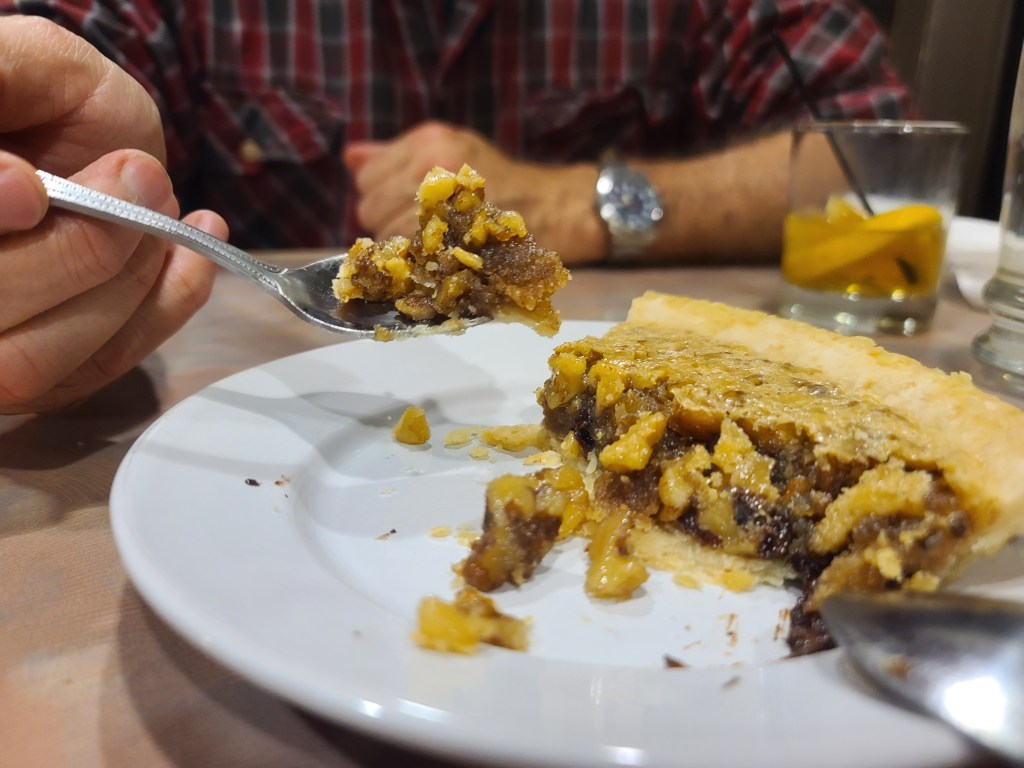
We found our place to have a drink! And we were introduced to Derby Pie, described as: like a pecan pie but also a chocolate chip cookie—it’s a Kentucky thing.

So…. I usually do NanoWriMo Flash with Nancy Stohlman. I will be checking in there. I will also be joining my mentor-in-flashing, Meg Pokrass, with her 300 words or less stories.

But… as of not even five minutes ago, I signed up for the novel version. Because it’s about damn time.

So, real quick. I read The Whisper Man by Alex North at The W in Du Quoin, a place I am pre-disposed to like because it is a horse facility. No horses in sight (except for a chestnut mare in a disagreement with a dog, glimpsed briefly in a back pasture), but still, the place gots good vibes. I was fireside with a flight of fall cocktails. Pictured is a cider and brandy combo.

Truly chilling book. A serial killer with a little tinge of supernatural. And about how crime and trauma affects people in our society, calling to some in a gruesome way. Also, families and love and trust.

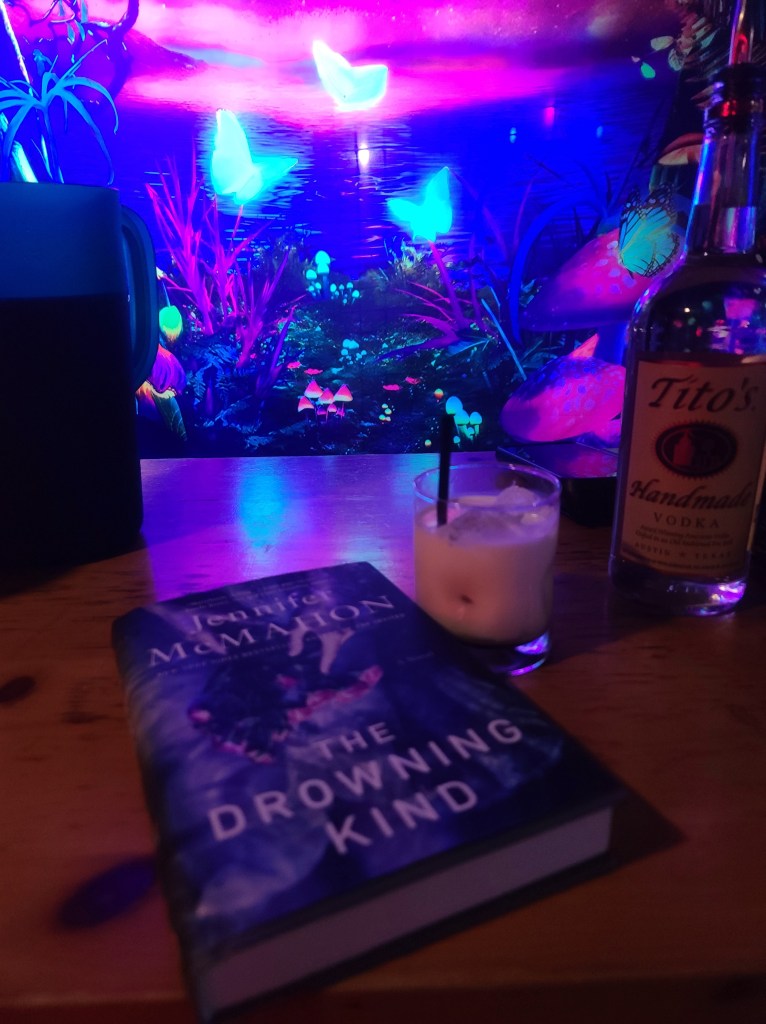
I tore through The Drowning Kind by Jennifer McMahon. Characters in McMahon stories are so damn believeable, relateable, even—even when they do strange things. Like become obsessed with a cursed spring that grants wishes and cures ailments. This is a story about sisters, generational inheritance, curses, blessings, and the importance of being very, very careful what you wish for.

It was right before Halloween. Tim had a basement gig—but it was a cool basement, and only a little bit haunted. That’s a Skrewball Russian sitting between my book and the Tito’s. Cool backdrop, eh?

As always, read more, and read more horror. And now I need to get my NanoWriMo set up. See ya’ round!

#nerdinabarwithabook

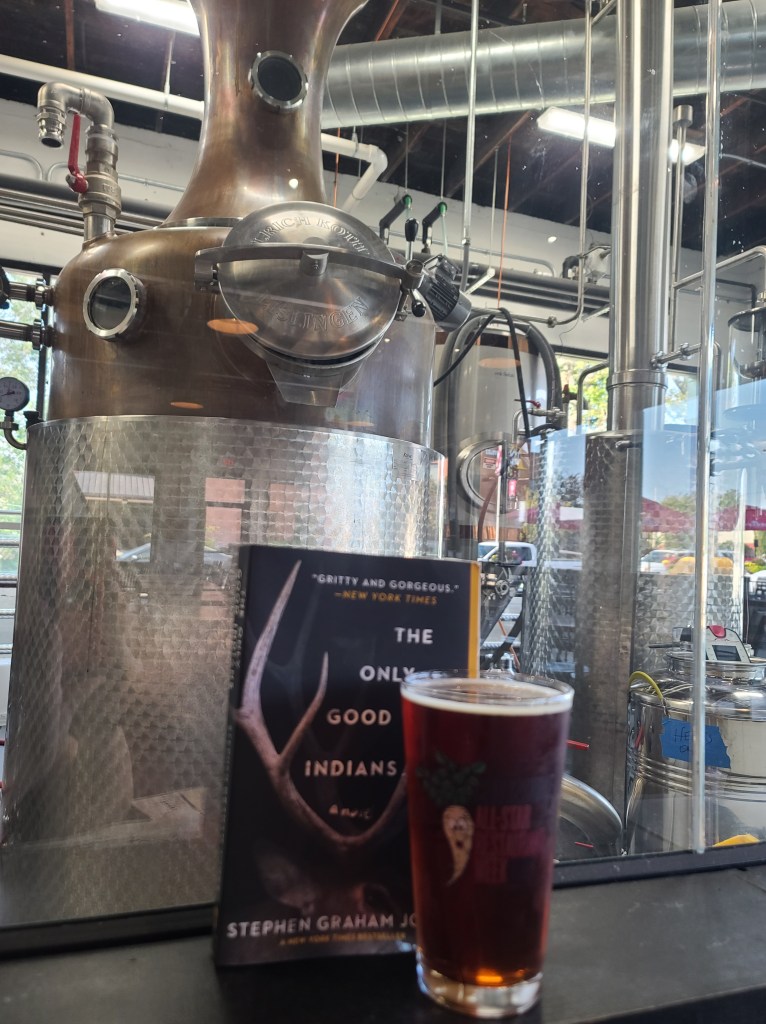
A trifecta of folk horror. I was reading The Only Good Indians by Stephen Graham Jones while I was at Archon 46, a sci-fi and fantasy event featuring writing hero Jonathan Maberry. Whom I got to meet. And to hand-deliver a bottle of local Chambourcin after alerting him to the presence of a wine trail here in Southern Illinois.

Back to the book. Holy shit. SGJ wrecks me. In a good way. But I will have to take a few deep breaths from now on before starting reading. The Only Good Indians is a wonderful example of what happens when someone breaks a rule pertaining to the Other world and doesn’t know it or doesn’t take it seriously. In this story, four young Blackfeet men know they broke a rule—they hunted elk in a section reserved for their elders. Ten years later, they begin to realize they did more than poach—they transgressed. They have made an enemy of Elk Woman. And her fury is implacable. Their (self) destruction is painful to witness, and the struggle of those around them to avoid becoming collateral damage is heart-rending.

I stopped in at the Old Herald Brewery & Distillery for lunch and an Oktoberfest. The building is the former offices and printing site of the Old Herald newspaper. This ex-reporter appreciates the theme, carried through as it is on some of the menu items.

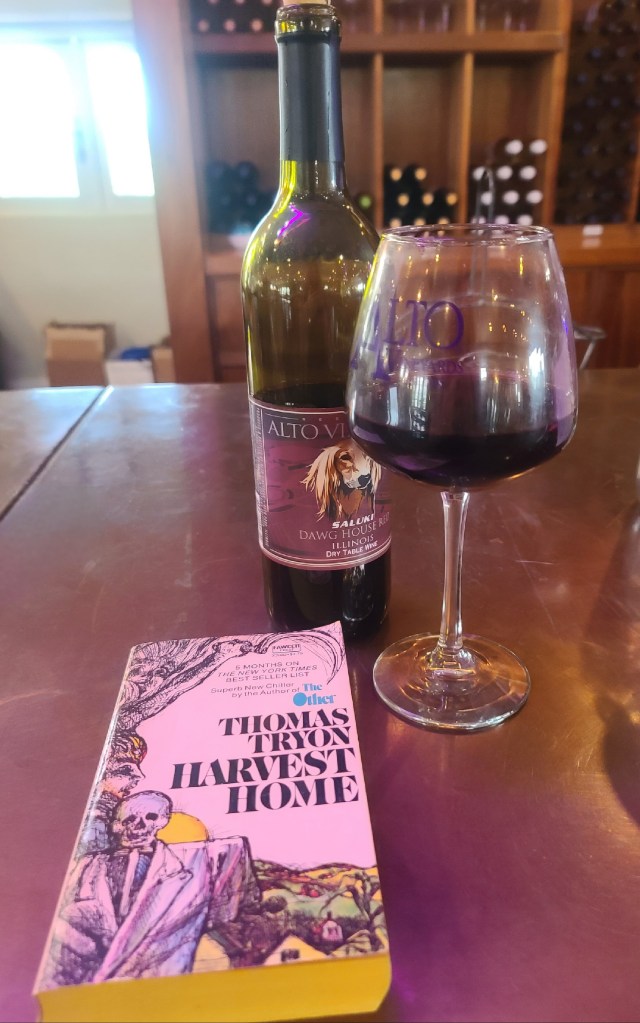
Harvest Home, by Thomas Tryon, makes just about every list of folk horror ever. I am late to the party, but can confirm—folk horror gold.

This is another one where the main character, Ned Constantine, knows he broke a rule. He fails to consider the consequences. Ned brings his wife and daughter to the quaint farming village of Cornwall Coombe, where they resolve to embrace country living and leave behind the pace and distractions of NYC. Ned counts befriends young malcontent, Worthy Pettinger. Ned begins to understand the nature of the strange pseudo-religious beliefs in the community, and the role of the Widow. Fearing for Worthy’s safety after the young man disappears, Ned determines to uncover the mystery. One great thing about this slow-build book is how the reader is constantly two or three steps ahead of Ned. You get the thrill of discovery as the plot unfolds, and the dread of watching Ned make mistake after mistake.

I was at Alto Vineyards for this one, drinking a Chambourcin blend, Dawg House Red. It should have been mead…

I just finished reading The Hunger by Alma Katsu. Katsu makes the horrific story of the Donner Party—the pioneers who resorted to cannibalism to survive after forced to winter in the mountains during their ill-advised shortcut to California—even more gruesome and terrifying. Blending folk tales and dread whispers from German settlers and Native Americans of several tribes, Katsu creates a threat that is monstrous, vicious, and horrifying when you realize what “the shadows” are and where they originate. While this book is clearly fiction, equally as clearly Katsu did plenty of research. It’s easy to lose yourself in this book, and to feel kinship with some of the characters.

I was at a nearby winery, Starview Vineyards, drinking Chambourcin, the same wine I brought to Archon. That oak tree you can see in the background is one of my favorite trees in the area, and is a true landmark.

Remember: read more horror. And share what you are reading!
#nerdinabarwithabook

A horror trope I always love is when a person innocently or carelessly breaks a rule they didn’t know about or thought didn’t exist. It’s scariest when they realize, after it’s too late, what has happened, and then try to save themselves, right the wrong, or appease the monster.

This story, “A Fine Trade,” from a trio of my stories that appeared in Parhelion Literary Magazine, Halloween issue 2022, explores that trope—though the tone is more dark humor than horror.

The reading is on Devil’s Kitchen Lake in Southern Illinois, the Goth lake of the area. It’s a flooded valley, and a tree graveyard. Other footage is from the Seven Bridges Natural Area in Rapid River, Michigan.
And here’s what’s really cool—I didn’t throw my phone overboard this time!
Enjoy. Read horror. Read flash fiction too.