I hit 50,000 words yesterday, a whole two days before deadline. And for me, it is an accomplishment. I started writing a novel several years ago, and have set it down several times. I signed up for NaNoWriMo (National Novel Writing Month) for the first time as a do-or-die—finish a draft of the novel, or forget about it.

So I went for it. I did not write every day, but I did write consistently. The novel is not finished. There are probably 10 more chapters to go. My notes for the second draft are extensive. There are many fixes I’ll need to make—time inconsistencies, point of view and tense departures, plot developments that need foreshadowing, and pacing—my biggest challenge.

The end is in sight. I see a path to the end of the novel, and I’ve already got the scaffolding for the fixes. I’m all kinds of insecure about it. But also hopeful.

In addition to the formal NaNoWriMo, I was participating (trying to) in a 300-word story NaWriMo challenge. That kind of writing is so dear to me. With the novel, I’ve got a detailed outline that I update after each chapter and where I’ve made my story-fix notes; a character list; and a time-line with details that won’t necessarily make it into the story.

I write flash mostly from prompts: word prompts are my favorite, picture prompts next. Sometimes an open-ended suggested direction is helpful. But a prompt that says “Write a story about X leaving Y and encountering Z” is way too specific for me most times.

Once in a while I have an idea when I sit down to write flash, but most of the time I haven’t a clue. It’s an exploration, an adventure. I may write myself into a hole and back out again, and find the beginning of the story somewhere in the middle. Or, occasionally, the story explodes in about the second sentence, blooming into something I know I want to keep. Often, I write myself off a cliff and know there are no survivors—not a single sentence or phrase or image.

Writing every day for 30 days is a worthy aspiration. NaNoWriMo is like a detox cleanse, boot camp, sweat lodge, a period of fasting, training for a marathon—in short: a time set aside for a disciplined, rigorous attack on your goals.

I knew I wouldn’t be able to write every day when I signed up for NaNoWriMo—there are other areas of my life that require my attention. I’m sure a 30-day stretch with no misses is hard for many writers. Writing consistently, though—that’s crucial. Writing has to be part of your normal routine. If it is, then those times when you must take a break—for whatever reason—your good writing habits stay with you, and it will be easier to get back on course when you can. If you’ve never been on course… well… it gets easier and easier not to write. That’s where I was with the novel. The 30 days of focus on it has given me the determination to finish.

Thanks for hanging out with me, and for all the encouragement so many people have given me over the years. I hope to make 2024 my best year yet!

I find that a couple nights away from home with the intention of writing like crazy, works. Partly because I go there with the express intention of writing. Partly because we are paying for it, so feel the need to get the most out of it. Or maybe especially because I rarely indulge in a writing retreat. In fact, this was only my second one ever!

So. Tim and I went to Falls of Rough, Kentucky, on the Rough River Lake. I had about a dozen places picked, and ultimately we went with the cheapest. (Heh) My selection criteria were: a place to write, a place with some privacy for Tim to work on a song, a place to walk, affordable, food options.

We got most of those in Falls in Rough.

I want a place for a writing retreat that is cool—but not too cool. In other words, a place I enjoy visiting. But not somewhere that makes me want to go outside and play more than write.

We stayed in a wee little log cabin in a lake neighborhood. I filmed a story reading in the loft—you’ll see it here later. The weather was pleasant for November, so Tim did a lot of his work in the fantastic gazebo on the property. We brought the dogs along, and they hung out on the porch, in the fenced backyard, or underfoot.

Sundance insists on looking out the front window. Banjo is content to curl up and chill out.

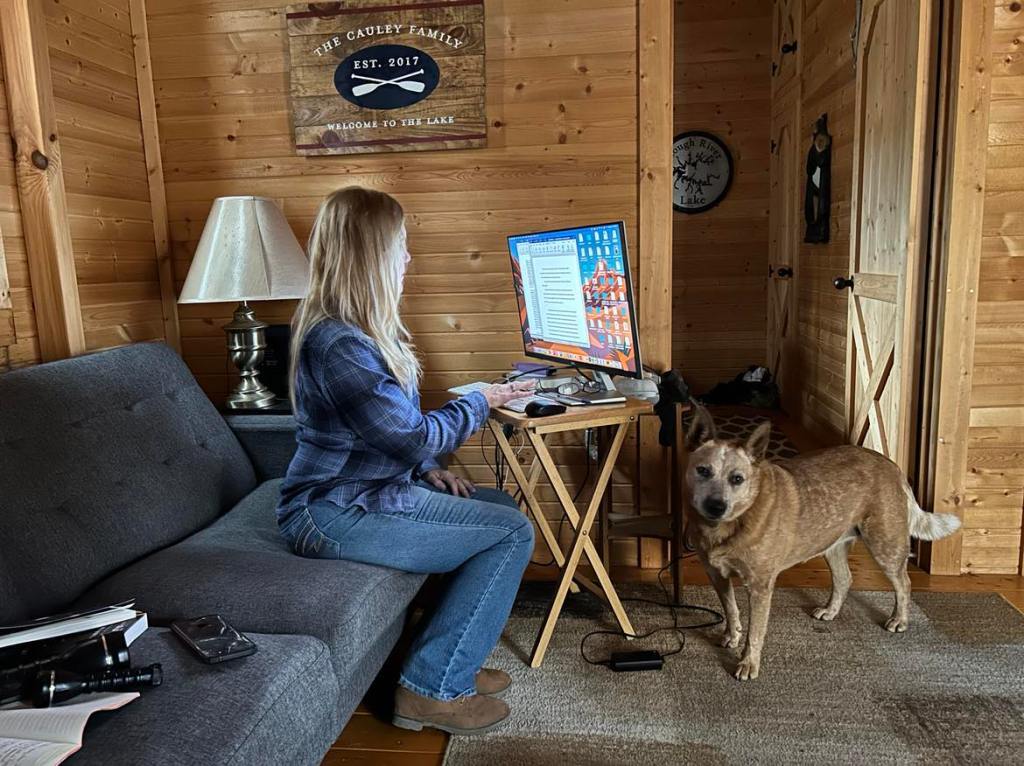
For my writing area? I wound up using a TV tray for a desk. Not even kidding. And I took my computer, not a laptop (my Chromebook is my laptop). So I was all cramped, not even able to use the mouse properly, hunched over and sitting on a couch in a corner of the living room.

It was great. I mean it. I got so much done!

I signed up for NaNoWriMo with what I called a new project, but which is only partly that. So what I was able to do on this writing retreat was to get all the way through what I already had, doing some small re-writes, and making notes of continuity problems, timeline issues, sucky sections, and character inconsistencies. I have a LOT of work to do on this novel. But right now the important thing is to finish the draft.

I wrote a trio of flash stories while I was there, too. One of them shall not see the light of day. The other two have some potential.

When we weren’t writing songs and stories, we explored the area. The nearest actual town is Leitchfield, and we went there, mostly, to eat. A highlight of the trip was me peering in restaurant windows that first night to try to guess if we’d be able to get a beer or other adult beverage with our meal.

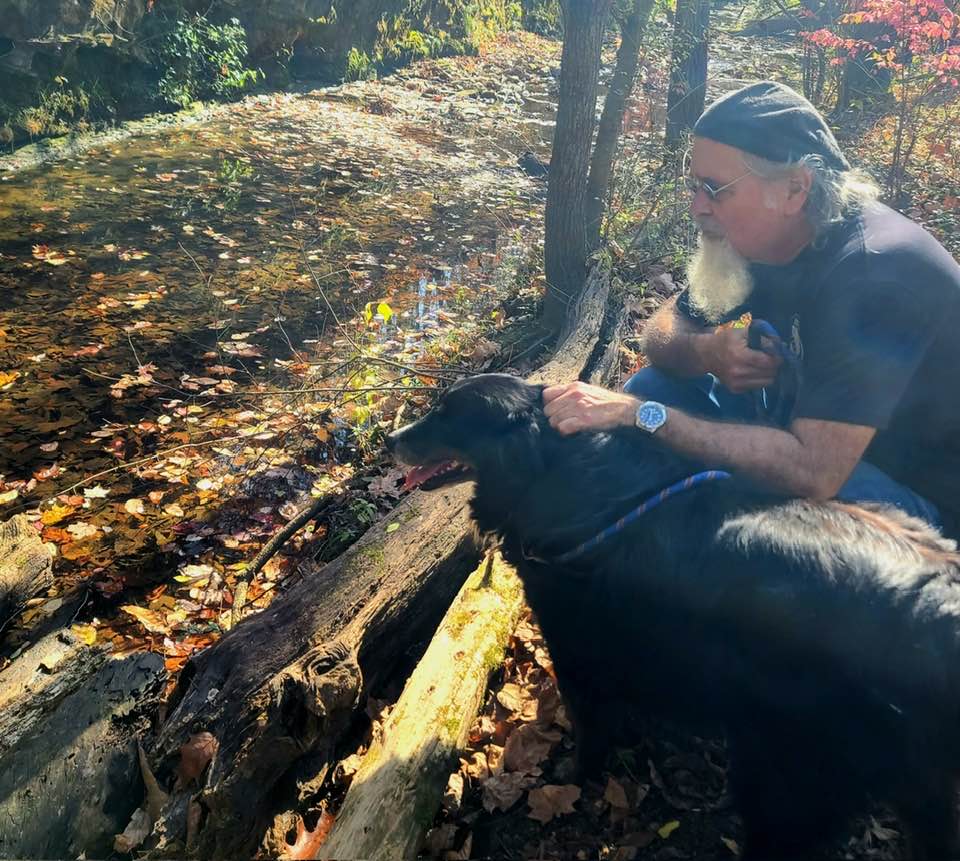
Tim and Banjo check out the fishies in the creek.

We hiked about 2 miles on the Taylor Fork Trail and area near it in Leitchfield. The park is in city limits, but the trail follows a creek and boasts some modest bluffs and rock formations, and the creek itself is pretty. There’s a spring-fed waterfall at the end of it—the dogs liked that part, and the creek crossings.

Home again now.

Got to keep that momentum going!

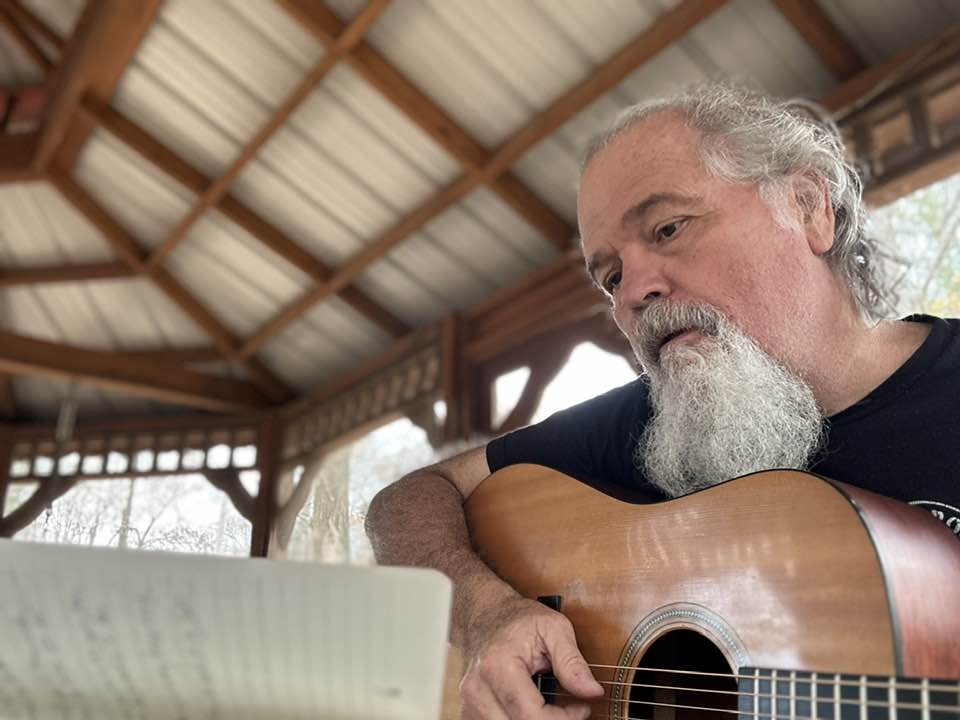
Tim working on a song in the gazebo.
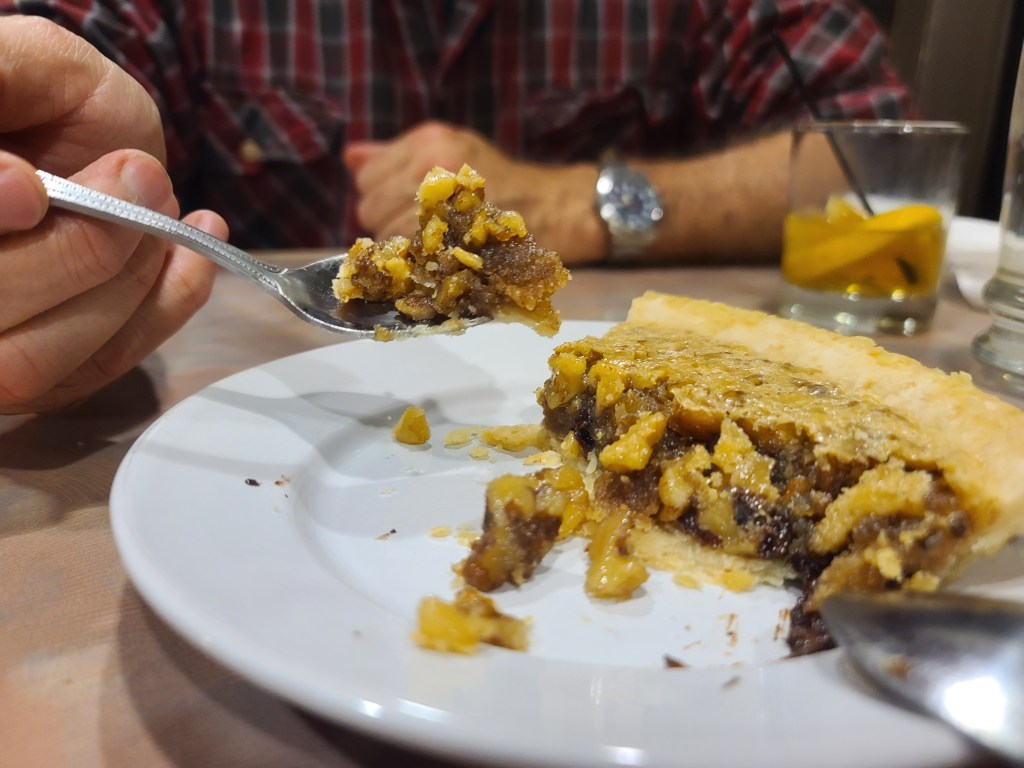
We found our place to have a drink! And we were introduced to Derby Pie, described as: like a pecan pie but also a chocolate chip cookie—it’s a Kentucky thing.

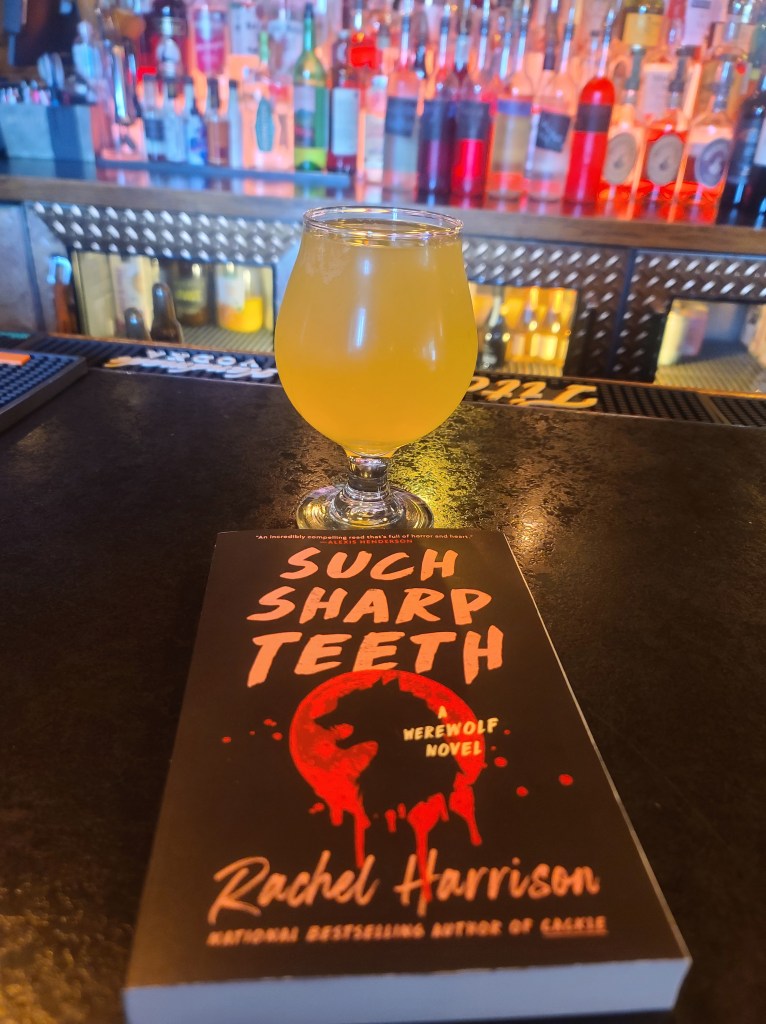
I had a quiet weekend, so I fell into this book headfirst and barely looked up until it was finished. Rachel Harrison’s Such Sharp Teeth is a blast. It’s got great characters, witty dialogue, low-key drama, high-stakes drama, werewolves… obviously. I mean this in a good way—it’s like Vampire Diaries but with werewolves and for adults who’ve paid off at least one car.

But this book also has its serious side, and that what makes it hard to put down. Aurora “Rory” Morris (how’s that for a cool nickname from a cool name?) is back in her hometown (from NYC) to help out her twin, Scarlet, who is very pregnant and not very sure how she feels about it. Rory is barely settling in when, yep, she gets attacked by a werewolf, and yep, becomes one. That’s not a spoiler. But I will tell you, the way Rory comes around to the realization of what has happened to her is good stuff. Even better is how everything comes together in a perfect whirlwind — Rory glimpsing for the first time how different her life could be with a little domesticity — and how different it could be as a truly wild thing. Can’t say more, read it yourself.

The drink is one of the many microbrews on tap at the Underground Public House. It’s from B. Nektar Meadery in Michigan—it’s their Orange Cream Delight, a mead with orange and vanilla. Delish.

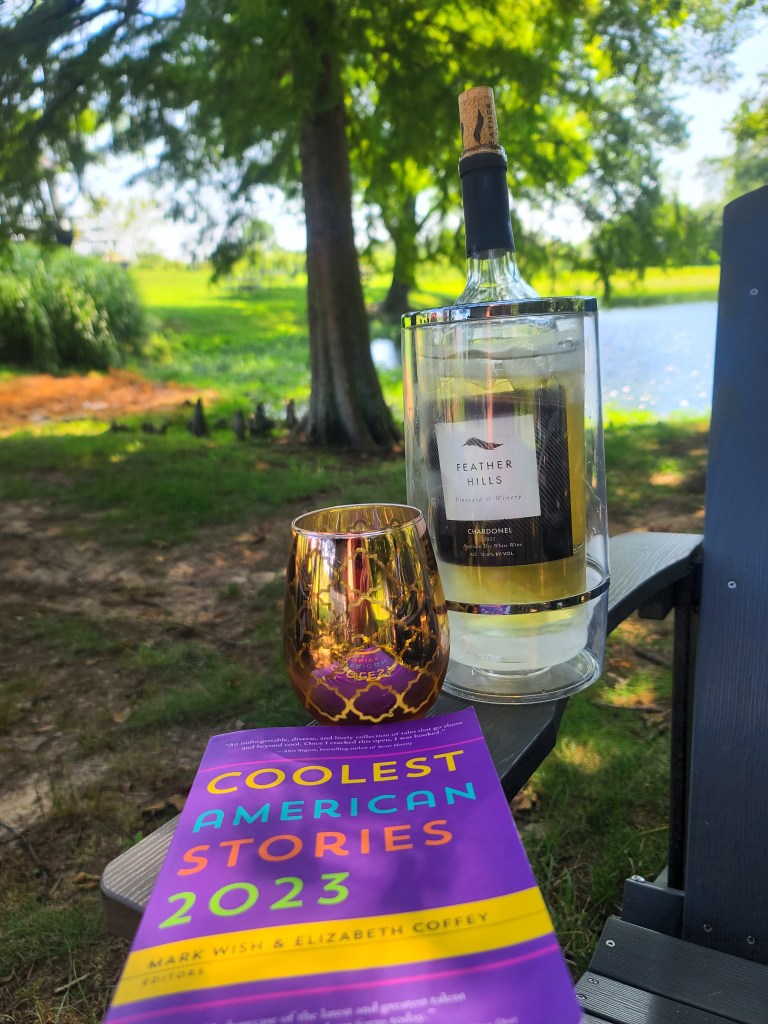
Coolest American Stories 2023, edited by Mark Wish and Elizabeth Coffey is an eclectic, exciting collection of stories. It’s their second of what’s becoming an annual anthology—they are accepting stories for the 2024 version as I’m writing this. Read their About section to understand fully what they’ve got going on with this book, but basically, they want stories that make you say, “Wow, that was a cool story,” when you finish it. They are literary stories, but accessible literary stories.

So, meet a celebrity stalker who knows how to take advantage of a situation, a woman trying to fulfill her mother’s puzzling last wish, a high school girl trying to stay true to herself in the face of deception and jealousy, and (the story that probably hit me most personally), a woman thrust into the role of grandmother, and then confronted with a devastating choice. It’s a fantastic collection.

The drink is a nice dry Chardonel at Feather Hills Vineyard & Winery. Check out the cypress tree in the background.

What are you reading, and where are you reading it?
#nerdinabarwithabook

Every place I’ve lived in Southern Illinois I’ve always been within earshot of a distant train—or better yet, coyotes.
Tim (my husband, singer-songwriter Tim Crosby) got me a couple trail cams for my birthday. Best. Present. Ever.

Nocturnal Trail Cam in May

Maybe I shouldn’t be so excited about chicken-eating predators so near our free-range chickens. But I am. A bobcat!!
When I lived at Broken Branch with Merlin and Crocodile and Odin (horse, horse, dog, respectively) and my son was little, the barn door had blown down—and that was most of the wall. Before my then-landlord set it back on track, a bobcat moved into the barn. I never saw her, but neighbors did. I heard her one night—an unearthly screech! The neighbor suggested I call the IDNR, maybe have her removed. “No way,” I said. “I have no ‘possums, no raccoons, nothing in the barn.” She wouldn’t hurt the horses. So we had a nice relationship for a while.
Underhill, though, our home now is a berm home across from the Shawnee National Forest. A creek circles most of the back pasture where eventually we’ll have horses again. We’ve got lots of neighbors we never see. Enjoy!

I was asked to write a craft essay for the forthcoming edition of Best Microfiction — a first for me, and a huge honor. It got me thinking about how I started writing flash fiction, and why I love the genre so much.

To give a simple answer: Meg Pokrass got me started writing flash fiction. Meg, and the community she created.

If you haven’t already discovered Meg Pokrass, remedy that immediately. Any of her books will do, they will all leave you gasping for breath. I don’t know anyone who writes quite like Meg. She’ll break your heart and you’ll laugh while it’s happening. No one gets the beginning of how things end the way Meg does. She can tell a story set in the past, or one set right now, and it all feels like something you’ve remembered, or something you’ve only just now understood though it was there all the time. Every single thing in a Meg Pokrass story means something, but her stories are never weighed down, they are never pompous.

I found Meg on Facebook when social media was still fairly new. I don’t remember exactly how. Meg posted prompt words nearly every day. And a large community of writers used them and posted their drafts there. So I started to do it, too.

Meg’s instructions were to use all the words — usually 8-10 of them — in a story written in about 20 minutes of continuous writing. In other words, a timed freewrite.

I confess at first I thought these freewrites were merely writing exercises, something you did on your way to whatever it was you were really going to do. But then I started hearing this term “flash fiction.” And I noticed how the other stories from the prompts were put together, how they worked as full stories and packed an outsized punch.

Meg’s first book, Damn Sure Right, was still new. I bought it — and the sun shone through the clouds, and birds sang, and rainbows arced, and brooks babbled merrily. I got it all at once, what flash fiction was about, what it could do, why it is so powerful. An epiphany, if you will…

It wasn’t just reading Meg’s work, though. It was reading everyone else’s stories on the page, too, watching how they used language, developed characters, moved the narrative — all in less than 1,000 words. What’s more, these accomplished and well-published writers offered kind feedback on each other’s stories — and on mine too!

From the comments made on my stories — or not made — I began to understand where I’d been successful and where I still needed to work. Meg herself was always encouraging. Others in the community — Charles Rammelkamp, the late and much-missed David James, James Claffey, Morgana McLeod, Francine Witte, Frances Leibowitz, Michael Dwayne Smith, Sherrie Flick, Rosemary Tantra Bensko, so many others — were kind to newbie me. Sometimes they saw a gold nugget in a story I thought was a throw-away. Occasionally, someone would suggest an edit, and as I tried out the suggestions, I began to understand how to craft my work.

One of my favorite things in reading the other stories was seeing how everyone else used the prompt words. Sometimes several writers would use several of the words the same way, sometimes even in the same word order. Other times, someone would bend a word in a way I didn’t know it could be bent! Meg in particular is a master of this, with a James Joyce-level of attention to details and bits of truth that are simple on the surface, but weighty as an iceberg with lurking (and often devastating) meaning.

I’ve kept most of my freewrites from then, dating back all the way to 2012. Some of them are embarrassing! I’d write with mad passion, deeply personal but without much relevance for anyone else — like writing a diary entry — and call it a story. That kind of confessional writing was good for me, cringy though it is for me now. It was instrumental in teaching me to shut down that inner critic, to write now and edit later and to get out of my own way.

From that freewrite community, I learned to play with language and to allow even delicate words to do some heavy-lifting. I learned to write myself out of a hole, to take sharp turns when necessary, and to finish the story, not just let it trail off into mist. That it’s okay to throw away whole paragraphs, to begin the story at the end, to admit that this one just isn’t going to work. To write every day or at least regularly — and to expect some days to deliver sluggish and uninspired work. And that it’s important to share your work, and to get feedback on it, to have a writing community.

I’ve since taken plenty of flash fiction workshops: with Meg, Kathy Fish, Nancy Stohlman, Lorette Luzajic, others. I’ve learned something profound in every one, whether it’s a new approach to pulling a story out of the air, or an editing methodology for an unruly story that maybe has something to offer.

I’ll always write flash. I love the immediacy, the spontaneity, the unpredictability, the challenge. I’m writing some longer works now, including proper short stories. I’ve got a novella-in-flash going, a hybrid collection, and a horror novel. Flash is where I found my voice, though, and it’s the well-spring that will always refresh.

“If everybody looked the same, we’d get tired of looking at each other.”

True.

I’ll add: If everybody thinks/believes the same, we’ll get tired of talking to each other.

Let’s lose the lockstep. It’s starting to look to me like a goose-step.

Post links to your favorite sassy dance music here. I could use a dance party, y’all.

My base line, for which I do not apologize is: Fuck censorship.

I would rather deal with the problems of “too much” free speech than any of the problems of suppressing freedom of speech and expression. 

I’ve been going off on Facebook a bit about the proposed — and I think pending —bowdlerization of author Roald Dahl’s books for children — which I read as a kid, and read to my son when he was young. So I’m going to say a few words here.

When young readers encounter an author like Roald Dahl or Shel Silverstein, they know immediately this is something different. The tone. This isn’t an all-is-sunshine atmosphere, this isn’t Disney, this is darker. They instinctively know to be wary.

And they should be. 

Let’s talk about Charlie and the Chocolate Factory, probably the most famous of Dahl’s books for kids because of the two Willy Wonka movies. Dahl doesn’t hold back when he’s describing the children who tour the magical factory. His narrator is a bit mean. Most kids reading this tone will feel a little bit uncomfortable — and ultimately probably a little bit defensive of at least some of the children. 

It’s masterful, really. A reader starts out not liking the children, and then finds herself confronted with the notion of justice, and mercy. All the children broke rules in the factory — and they all broke rules according to their own natures. Of course Augustus Gloop is going to be tempted to break a rule (which he learned after the fact, if I remember correctly) pertaining to eating candy. Of course Mike Teavee is going to be so focused on television waves that he ignores the rules. Young readers realize the kids broke the rules and were punished — but did they really get what they deserved? And what does that mean anyway? Is it justice? What about the role of mercy?

Of course young readers want Charlie to win. In the book, he wins the factory because he’s the last child standing — the others have all met their Oompa-Loompa-enhanced fates. Young readers want to be more like Charlie than like Veruca Salt or Violet Beauregard. 

And what is Charlie? He’s respectful, considerate, appreciative and lucky. 

And what is the factory? Well, on the tour, it’s a pitfall-ridden series of challenges. Not unlike life. 

Charlie and the Chocolate Factory is exactly modeled on original, un-bowdlerized fairytales. And those tales taught lessons, too. Many of the same lessons. Be appreciative. Take advantage of opportunities. Be kind. Don’t go with the crowd — do what you believe is right. Be respectful, but not cringing. Be discerning — pay attention, and be humble enough to learn. 

That’s a lot for a kid’s book that is also crazy funny, snarky, complicated, silly, imaginative, and at times a bit scary. 

Kids can handle it. 

This bowdlerization of Roald Dahl’s books bothers me on many levels, not the least of which is my maxim: Fuck censorship. But also because of the contemptuous opinion of children the censors evince. Stop telling kids what to think. Let them figure out a few things on their own. Let them face challenges and learn to do the right thing. Let them understand that, even when someone has done something wrong, there ought to be a path back. And that some wrong behavior isn’t tolerable. Let them begin to understand that we are all shaped by our environments, but how we respond is up to us. Let them face meanies and baddies in literature, so that when they come upon them in real life, they know what they are seeing. Get out of their way a little bit. Have some faith. Roald Dahl did. 

What I’m Reading. And Where I’m Reading It. November 2022

Of course I always take a book on vacation. Usually two, in fact. Even if I’m pretty sure I won’t have time to read. So, here’s what I brought on the honeymoon at Gulf Shores — a horror novel set in the Gulf Shores. Of course. And I did not have time to read it. Instead of chilling with a book on the beach, I prowled the beach, up and down, from the condo across the Gulf Shores State Park and beyond, at least once a day. I finished the book back home in Southern Illinois. At a winery. Because of course that’s where I would read.

The Elementals by Michael McDowell. Big ol’ 5 stars. I may never look at a sand dune the same way again.

The wine is Peachbarn Winery‘s rosé. I often drink their Old School Peach, which is a dry peach. It’s like biting into a peach right off the tree, but not an overripe one. So freaking good. But their rosé is a real treat too.