I was asked to write a craft essay for the forthcoming edition of Best Microfiction — a first for me, and a huge honor. It got me thinking about how I started writing flash fiction, and why I love the genre so much.

To give a simple answer: Meg Pokrass got me started writing flash fiction. Meg, and the community she created.

If you haven’t already discovered Meg Pokrass, remedy that immediately. Any of her books will do, they will all leave you gasping for breath. I don’t know anyone who writes quite like Meg. She’ll break your heart and you’ll laugh while it’s happening. No one gets the beginning of how things end the way Meg does. She can tell a story set in the past, or one set right now, and it all feels like something you’ve remembered, or something you’ve only just now understood though it was there all the time. Every single thing in a Meg Pokrass story means something, but her stories are never weighed down, they are never pompous.

I found Meg on Facebook when social media was still fairly new. I don’t remember exactly how. Meg posted prompt words nearly every day. And a large community of writers used them and posted their drafts there. So I started to do it, too.

Meg’s instructions were to use all the words — usually 8-10 of them — in a story written in about 20 minutes of continuous writing. In other words, a timed freewrite.

I confess at first I thought these freewrites were merely writing exercises, something you did on your way to whatever it was you were really going to do. But then I started hearing this term “flash fiction.” And I noticed how the other stories from the prompts were put together, how they worked as full stories and packed an outsized punch.

Meg’s first book, Damn Sure Right, was still new. I bought it — and the sun shone through the clouds, and birds sang, and rainbows arced, and brooks babbled merrily. I got it all at once, what flash fiction was about, what it could do, why it is so powerful. An epiphany, if you will…

It wasn’t just reading Meg’s work, though. It was reading everyone else’s stories on the page, too, watching how they used language, developed characters, moved the narrative — all in less than 1,000 words. What’s more, these accomplished and well-published writers offered kind feedback on each other’s stories — and on mine too!

From the comments made on my stories — or not made — I began to understand where I’d been successful and where I still needed to work. Meg herself was always encouraging. Others in the community — Charles Rammelkamp, the late and much-missed David James, James Claffey, Morgana McLeod, Francine Witte, Frances Leibowitz, Michael Dwayne Smith, Sherrie Flick, Rosemary Tantra Bensko, so many others — were kind to newbie me. Sometimes they saw a gold nugget in a story I thought was a throw-away. Occasionally, someone would suggest an edit, and as I tried out the suggestions, I began to understand how to craft my work.

One of my favorite things in reading the other stories was seeing how everyone else used the prompt words. Sometimes several writers would use several of the words the same way, sometimes even in the same word order. Other times, someone would bend a word in a way I didn’t know it could be bent! Meg in particular is a master of this, with a James Joyce-level of attention to details and bits of truth that are simple on the surface, but weighty as an iceberg with lurking (and often devastating) meaning.

I’ve kept most of my freewrites from then, dating back all the way to 2012. Some of them are embarrassing! I’d write with mad passion, deeply personal but without much relevance for anyone else — like writing a diary entry — and call it a story. That kind of confessional writing was good for me, cringy though it is for me now. It was instrumental in teaching me to shut down that inner critic, to write now and edit later and to get out of my own way.

From that freewrite community, I learned to play with language and to allow even delicate words to do some heavy-lifting. I learned to write myself out of a hole, to take sharp turns when necessary, and to finish the story, not just let it trail off into mist. That it’s okay to throw away whole paragraphs, to begin the story at the end, to admit that this one just isn’t going to work. To write every day or at least regularly — and to expect some days to deliver sluggish and uninspired work. And that it’s important to share your work, and to get feedback on it, to have a writing community.

I’ve since taken plenty of flash fiction workshops: with Meg, Kathy Fish, Nancy Stohlman, Lorette Luzajic, others. I’ve learned something profound in every one, whether it’s a new approach to pulling a story out of the air, or an editing methodology for an unruly story that maybe has something to offer.

I’ll always write flash. I love the immediacy, the spontaneity, the unpredictability, the challenge. I’m writing some longer works now, including proper short stories. I’ve got a novella-in-flash going, a hybrid collection, and a horror novel. Flash is where I found my voice, though, and it’s the well-spring that will always refresh.
I designated March as vampire month. No particular reason. Nothing about March that suggests vampires. Random.

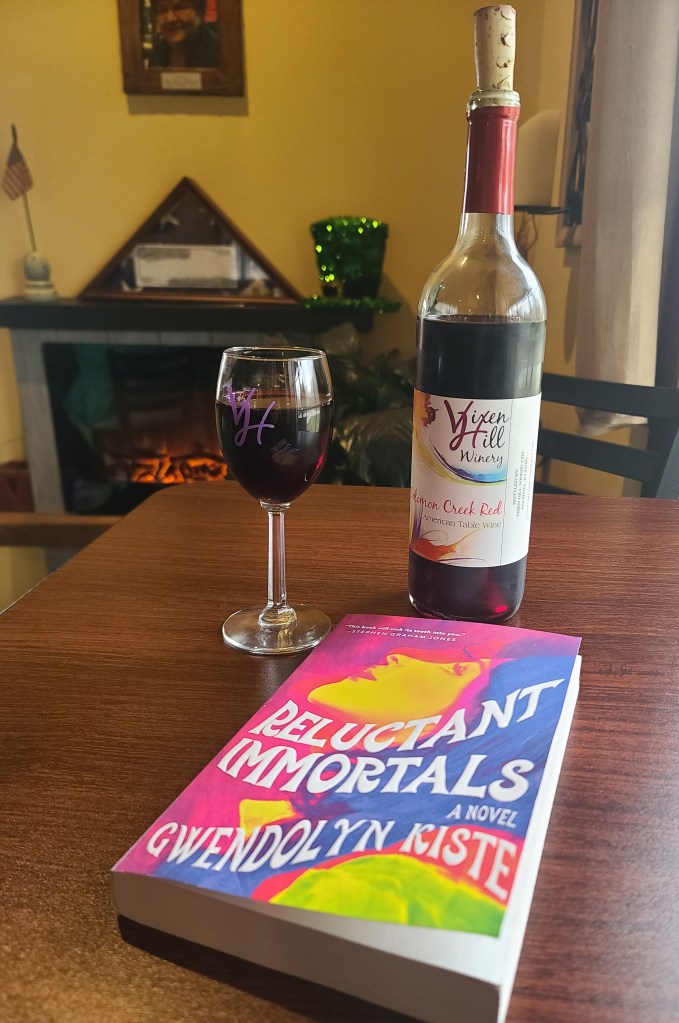
Reluctant Immortals by Gwedolyn Kiste should, first of all, win awards for such a cool cover. But once you are done admiring the cover, read this! Gothic / literary heroines (Lucy Westenra and Bee Mason) and villains (Dracula and Mr. Rochester), prepare for a final showdown in the 1967 Haight-Ashbury flower-child-strewn Summer of Love. You will love these characters. This feminist take on underappreciated female characters is smart, tough, tense, and sophisticated.

I was at Vixen Hill Winery in Palmyra, Illinois, enjoying a rich red wine (of course), Soloman Hill Red.

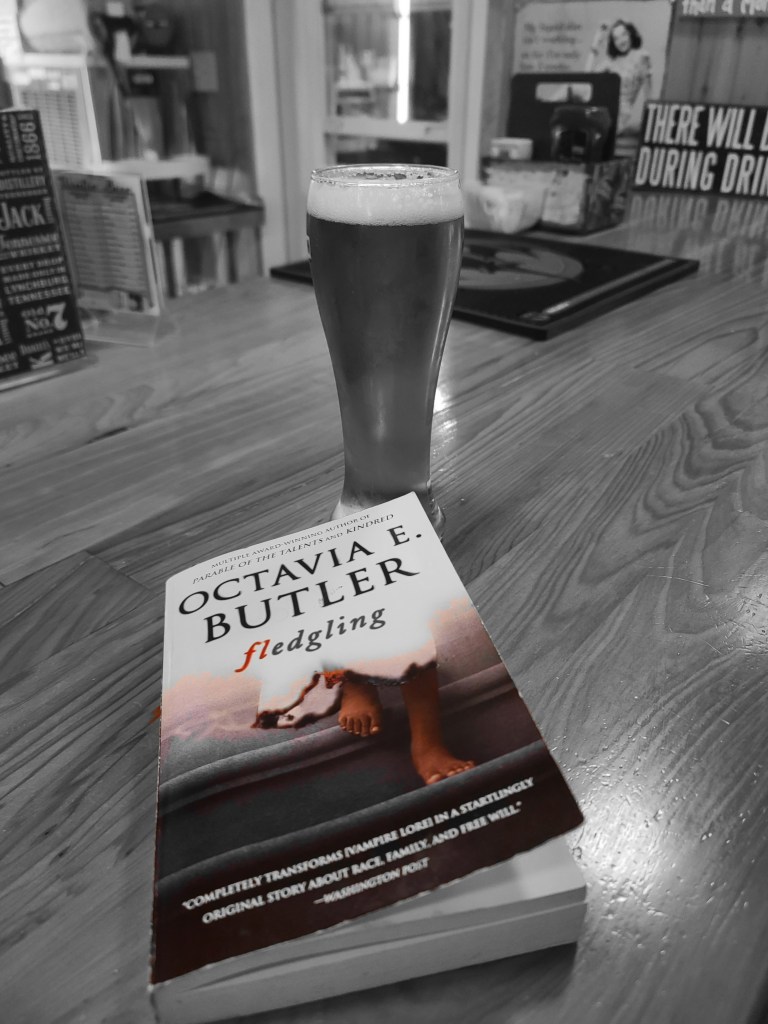
Octavia E. Butler’s Fledgling is a re-read for me. My first read was in 2014. It’s a strange, beautiful book. The vampiric protagonist looks much younger than she is, which makes for some unsettling images. Though the story is told from the young vampire’s point of view, I think this story has some of the best, most troubling and thought-provoking presentations of vampire victims I’ve ever read. As always with Butler, she challenges the reader to consider broader issues, including racism, genetics and consent.

I was at Huckleberry’s Pub with a good ol’ Samuel Adams Winter Lager.

The Mammoth Book of Vampire Stories by Women, edited by Stephen Jones, is a grand collection. I’m half way through, and no two stories have had anything more in common than a vampire in the story. Stories by authors I am familiar with and many I am not – but will be.

I was on the covered patio at Feather Hills Winery, on the Shawnee Hills Wine Trail, not far from our home. My beloved, Tim Crosby, is playing his original Americana / black dirt music. And I was drinking a red blend, Amalgam.  

Used to be, I couldn’t sleep with my back to a room. I had to have my bed shoved up against the wall, and my back had to be to that wall—touching it, even. I’m a little easier about that now. I’ll roll over in the night without waking up in full freak-out mode.

But I still must have a blanket on, no matter how hot it is. Over my ankles, at least. My knees. Because monsters. Don’t pretend you don’t know what I’m talking about—at least some of you have a similar fear.

I don’t know the rules monsters follow. And I don’t know why some people aren’t now or never were afraid of breaking monster rules. Reckless. Because monsters remember. They might not get you right away, the moment you transgress. They might wait years. The breaking of the rules gives then an in—even if you only slipped up just the one time.

Just the One Time by Epiphany Ferrell

I read this story on a boulder in the West Prong of the Little Pigeon River. Some of the footage is from trails either in the Smokies or Blue Ridge Mountains. Just the One Time first appeared in Ghost Parachute.

I apologize for the snap, crackle and pop. I couldn’t bear not to use this reading even though there are some sound issues. Working on it!

#nerdinabarwithabook

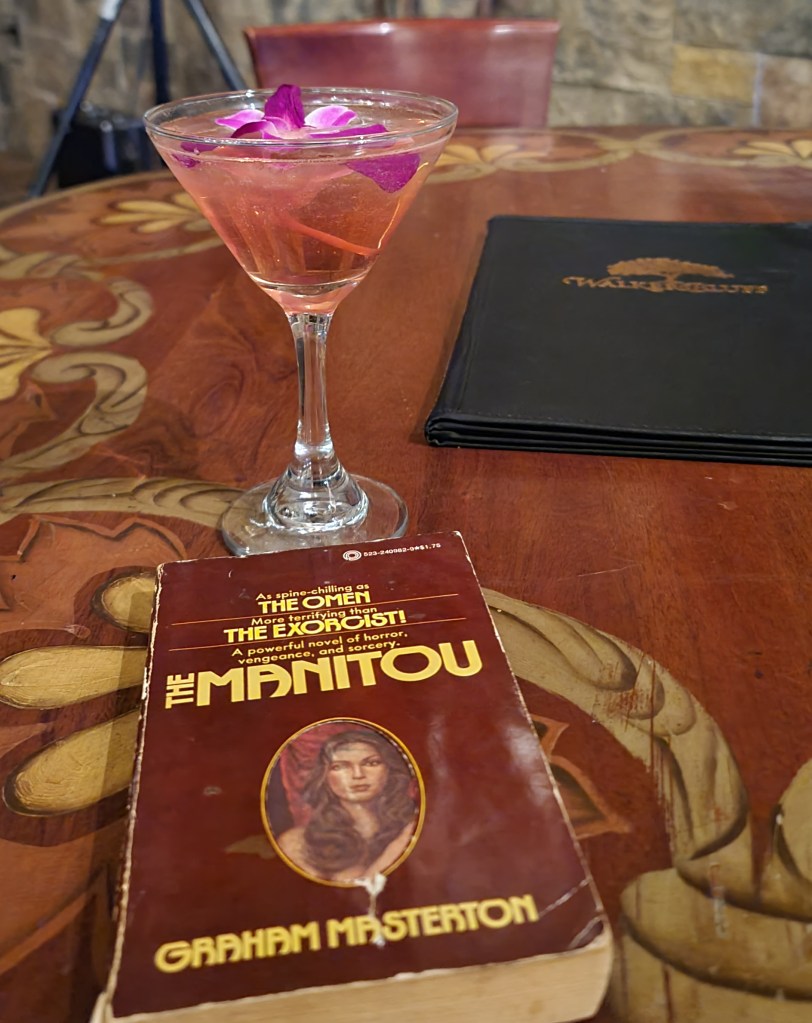
I’m one of those people who sometimes causes computers to malfunction just by walking into the room. It happens with other machines, too. Motorcycles, snowmobiles, wave runners. So I’m on the fence a little bit about technology being the nemesis of the manitou in The Manitou by Graham Masterton, a classic in the horror genre. (Also, I did not realize the book was the first in a series until I pulled it up on Amazon to share the link.) At the same time, it makes good sense, and is right in line with what I’ve learned from old fairytales and folklore—some of our friends from the other side of the veil do even less well with technology than I do.

That drink is a fancy cocktail enjoyed at Walker’s Bluff – Tasting Room. I can’t remember what was in it, but it the garnish was an edible flower. I ate a petal. Because of course I did. It was called a flower child. Pretty.

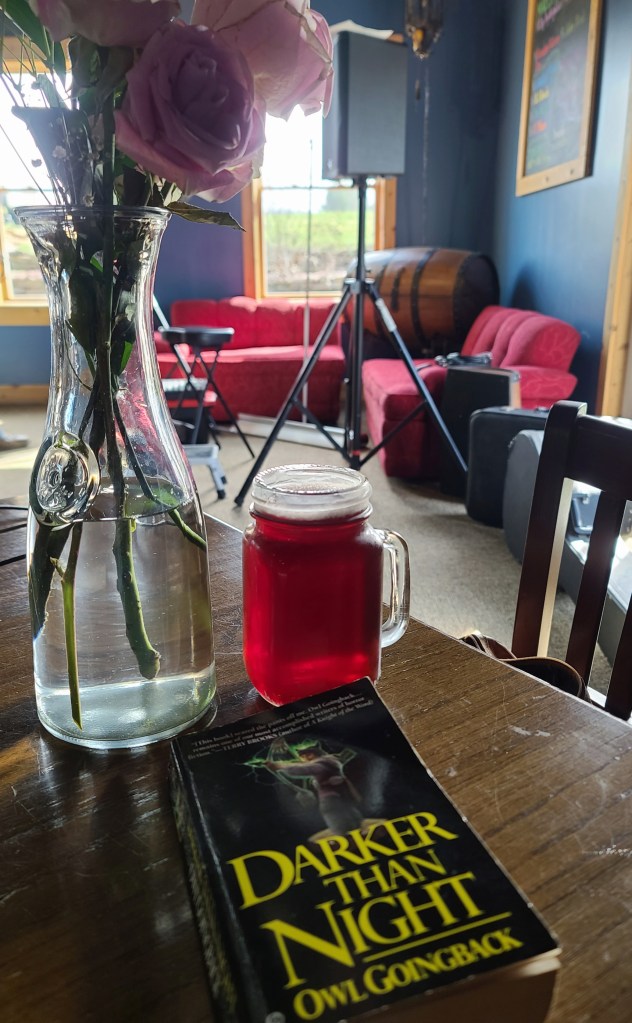
Used book stores are the bomb. I love to buy new books hot off the presses, help out a writer in the process. But finding gems at used book stores is such a dang thrill, isn’t it? I knew I was going to Owl Creek Winery. So it’s only natural to read a book by Owl Goingback! Darker Than Night was published in 1999, but it has all the very best features of a 1970s horror movie. I’m reading it and all but shouting “Tell him!” “Believe her!” “Why are you doing that?” Also, if you move into a house overloaded with kachina dolls… don’t.

The drink is a blueberry basil cider. Owl Creek makes some of my favorite summer wines, but when I go there, I always wind up seduced by the cider.

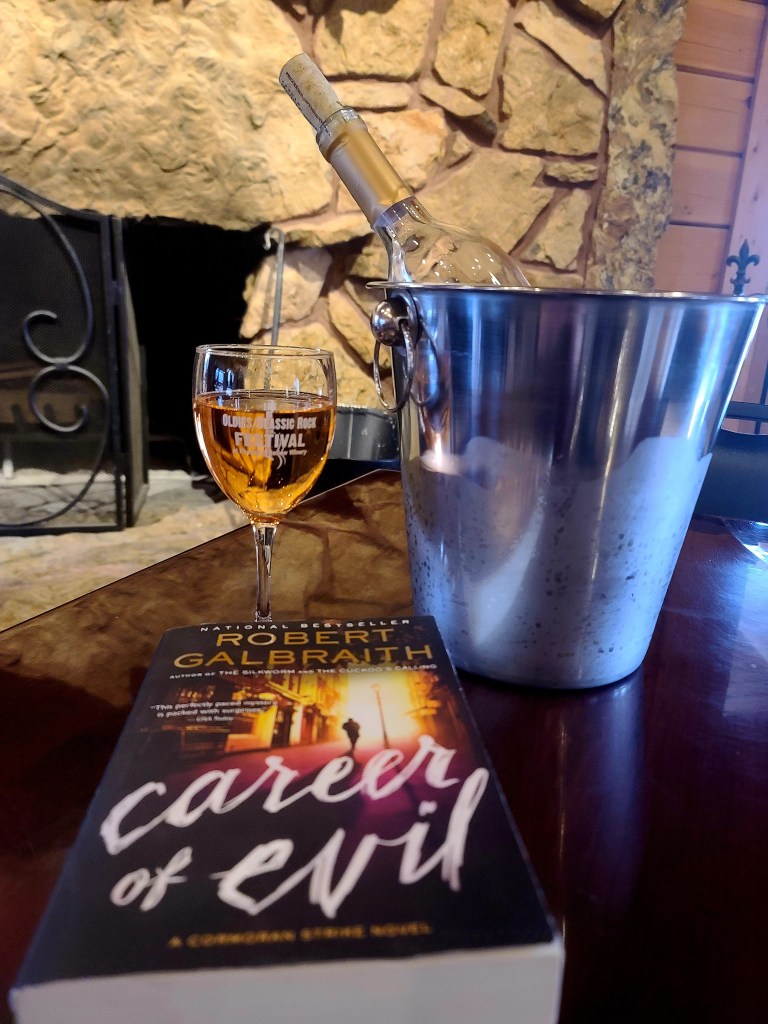
I always say I don’t want to start in a book in a series. It’s intimidating, picking up that first book and knowing there are six more to go. I mean, I got things to read, how can I commit to your series? And then I wind up captivated and reading the series. Countless times. This time, it’s the Cormoran Strike and Robin Ellacott mysteries by Robert Galbraith, aka JK Rowling. I read Career of Evil at Pheasant Hollow Winery with a Catawba wine. Catawba is a bit sweeter a wine than I typically drink, but it’s not an icky sweet—it’s got a nice earthiness to it, too. There are maybe three wineries I’ve been to that I really love the Catawba, and Pheasant Hollow is one!

Also, friends, please don’t worry. I have a backlog of these, I’m ok, really! 😉

“If everybody looked the same, we’d get tired of looking at each other.”

True.

I’ll add: If everybody thinks/believes the same, we’ll get tired of talking to each other.

Let’s lose the lockstep. It’s starting to look to me like a goose-step.

Post links to your favorite sassy dance music here. I could use a dance party, y’all.

What I’m reading and where I’m reading it. And what I’m drinking for part of the time I’m reading it.

So, this first one is a book about a woman driving alone in the mountains on her way to a horror convention, and encountering the Mothman or something like it and assorted other baddies along the way. For reasons I’ll explain in mid-April, that one skeered me. Below by Laurel Hightower is genuinely scary but it’s also empowering.

I enjoyed that book at Ebb & Flow Fermentations in Cape Girardeau, Missouri. Ebb & Flow has got just the best vibe. Inside it’s eclectic funky, and outside it’s herb garden magic. It’s February, so we’re inside. They have a series of beers named after goddesses and made by their women brewers. This one is Arduinna, which they describe as a dark saison ale with chocolate malt and roasted hickory bark. It was a perfect match.

Into the Forest and All the Way Through by Cynthia Pelayo is a collection of poems based on real life / true crime stories of murdered and missing American women and girls. It is heartbreaking. It’s one thing to read or write fiction that has murders — even if you are drawing from your own experience, you know the story itself is fiction. It’s another to write true crime — most of that is written in a clinical, research-forward way. Cina Pelayo goes into the heart and all the way through to your soul. I’ve not read anything quite like it.

So after all that seriousness, it seems almost stupid to talk about reading it in a bar during Valentine’s week. Johnson Bar in Paducah, Kentucky was all done up for the holiday, in reds and blacks and pinks and hearts and arrows and naughtiness and snarkiness and a nod to the heartbroken. The red lighting made the pictures kinda cool. That’s a Paloma I’m drinking — they do complex cocktails very well, but that night I was more traditional.

I am honored to call Meg Pokrass my friend. She has been my flash fiction mentor, a source of encouragement and inspiration, and a supporter when I needed a hug followed by a kick in the ass (all virtual). She lives now in Inverness, Scotland, the gateway to Loch Ness, and if Nessie is going to show herself to anyone, it’ll be Meg. They are two of a kind — mysterious, shy, beautiful and playful. Kissing the Monster Hunter is a series of flash fiction stories about a monster hunter. And love.

I was at Hill Prairie Winery upstate in Oakford, Illinois. They have historic pictures of horses on the wall — Morgans, a Percheron stallion, mules, work horses, all of them previously associated with the place in days of yore — so you know I loved it. The wine in this picture is Fireside Cran-Apple Spice, which tastes like a mulled wine.

Cheers!

My base line, for which I do not apologize is: Fuck censorship.

I would rather deal with the problems of “too much” free speech than any of the problems of suppressing freedom of speech and expression. 

I’ve been going off on Facebook a bit about the proposed — and I think pending —bowdlerization of author Roald Dahl’s books for children — which I read as a kid, and read to my son when he was young. So I’m going to say a few words here.

When young readers encounter an author like Roald Dahl or Shel Silverstein, they know immediately this is something different. The tone. This isn’t an all-is-sunshine atmosphere, this isn’t Disney, this is darker. They instinctively know to be wary.

And they should be. 

Let’s talk about Charlie and the Chocolate Factory, probably the most famous of Dahl’s books for kids because of the two Willy Wonka movies. Dahl doesn’t hold back when he’s describing the children who tour the magical factory. His narrator is a bit mean. Most kids reading this tone will feel a little bit uncomfortable — and ultimately probably a little bit defensive of at least some of the children. 

It’s masterful, really. A reader starts out not liking the children, and then finds herself confronted with the notion of justice, and mercy. All the children broke rules in the factory — and they all broke rules according to their own natures. Of course Augustus Gloop is going to be tempted to break a rule (which he learned after the fact, if I remember correctly) pertaining to eating candy. Of course Mike Teavee is going to be so focused on television waves that he ignores the rules. Young readers realize the kids broke the rules and were punished — but did they really get what they deserved? And what does that mean anyway? Is it justice? What about the role of mercy?

Of course young readers want Charlie to win. In the book, he wins the factory because he’s the last child standing — the others have all met their Oompa-Loompa-enhanced fates. Young readers want to be more like Charlie than like Veruca Salt or Violet Beauregard. 

And what is Charlie? He’s respectful, considerate, appreciative and lucky. 

And what is the factory? Well, on the tour, it’s a pitfall-ridden series of challenges. Not unlike life. 

Charlie and the Chocolate Factory is exactly modeled on original, un-bowdlerized fairytales. And those tales taught lessons, too. Many of the same lessons. Be appreciative. Take advantage of opportunities. Be kind. Don’t go with the crowd — do what you believe is right. Be respectful, but not cringing. Be discerning — pay attention, and be humble enough to learn. 

That’s a lot for a kid’s book that is also crazy funny, snarky, complicated, silly, imaginative, and at times a bit scary. 

Kids can handle it. 

This bowdlerization of Roald Dahl’s books bothers me on many levels, not the least of which is my maxim: Fuck censorship. But also because of the contemptuous opinion of children the censors evince. Stop telling kids what to think. Let them figure out a few things on their own. Let them face challenges and learn to do the right thing. Let them understand that, even when someone has done something wrong, there ought to be a path back. And that some wrong behavior isn’t tolerable. Let them begin to understand that we are all shaped by our environments, but how we respond is up to us. Let them face meanies and baddies in literature, so that when they come upon them in real life, they know what they are seeing. Get out of their way a little bit. Have some faith. Roald Dahl did. 

A foggy early January day and mysterous atmosphere led me to drive around looking for cool places to hang out. It’s not hard where I live. I found a spot near the Panther Den Wilderness area not far from a really cool attraction, the Shawnee Bluffs Canopy Tour, a zipline and suspension bridge site.

This story, Renaissance, is a re-write from an older, much longer story I wrote several years ago and shelved. I knew I wanted to do something with it. What needed to happen, as it turns out, was for me to whittle down the word count to just less than half of the original — and then to do that again.

The story appears in Legerdemain: National Flash Fiction Day Anthology 2021, edited by Santino Prinzi and Nod Ghosh. It’s really an honor to be included in the anthology.

What I’m reading, and where I’m reading it.

I forgot to include this one in the last round.

Sour Candy, by Kealan Patrick Burke, a novella that had me cringing with every page. Not gross-out cringing, but “this is a nightmare and I want to wake up but also see what’s going to happen” dread cringe. In the very best way. Tragic, occasionally funny, always scary.

This picture is a little bit of a cheat because I’m not in a bar. I do occasionally read other places! This one is a lunchtime read at Harbaugh’s Cafe. Great cover, eh?

How High We Go in the Dark by Sequoia Nagamatsu is—and I don’t say this lightly—the most important book to come out about pandemics during the Covid pandemic years. Though he started writing it well before most people in the world had ever heard of a coronavirus, this book, which begins with the discovery of a centuries-old little girl who was killed by a virus, which is soon unleashed on the modern world, is relevant in a way a book deliberately about the real pandemic probably could not be. It’s about grieving and living, about family and purpose, it’s sad, and funny, and mysterious, and philosophical. I’m blown away. Also, I get to interview the author for the SIU Alumni Magazine. Cuz he went to SIU. Where I work.

I’m at Shotgun Eddy’s in Eddyville. The outdoor stage—which, in January, is not where Tim played—features a tie-line for horses. Eddyville bills itself as the Trail Riding Capitol of Illinois, and I’m pretty sure they own that claim. And yeah, that’s a good ol’ Stag beer.

Stay tuned. I’m reading now about the Mothman.